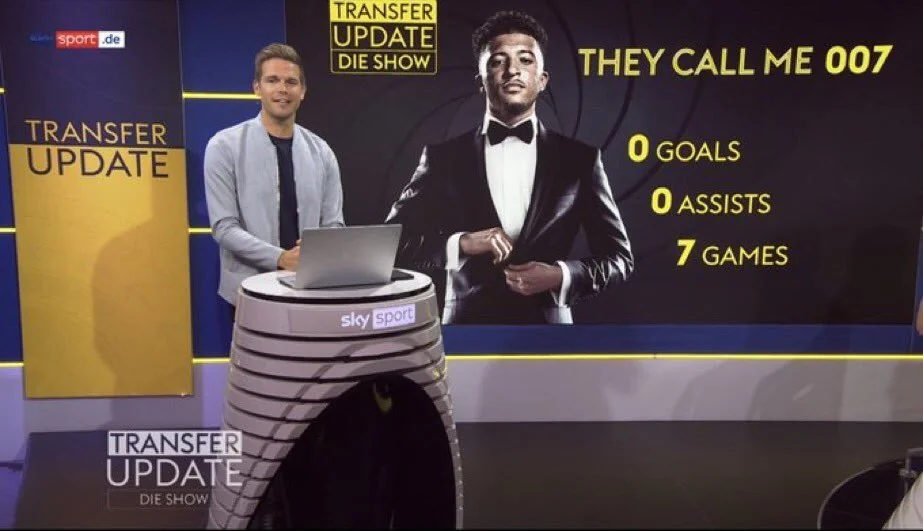
007. These numbers, once associated with the famous spy, James Bond, have taken on a new meaning in the world of football. “They call me 007…0 goals, 0 assists, 7 games” was the caption of a football post by Sky Sports Germany that now lives in social media infamy. The meme went viral after the transfer of Jadon Sancho to Manchester United in 2021, when he endured a difficult start to his Premier League career.
Football banter has always existed. But on Twitter, banter evolves at internet speed. A joke becomes a meme, and a meme becomes a trend. The 007 meme has now become a trend and is deployed relentlessly against new signings. Since Sancho, others like Kai Havertz and, most famously, Liverpool’s Florian Wirtz have been branded with this label.
On the surface, this meme is extremely funny and creative. I give lots of props to the Sky Sports intern who had the genius idea to photoshop Sancho onto James Bond. However, this label, originally meant as banter, has become a genuine label people use to judge the success of a player. Once a player is branded 007, every touch, miss, or substitution becomes a running joke. Fans cheer for failure simply to prolong the meme. Millions of rival fans tuned in to watch Florian Wirtz, hoping he would continue to fail. When Chelsea’s Mykhailo Mudryk managed to register an assist right before he reached 007, Chelsea fans immediately took to Twitter, celebrating their player for beating the 007 allegations and avoiding this type of humiliation. Twitter has become the new battleground for football and tribalism. The football game itself doesn’t matter as much. Rather, people view football through a lens of how you can ridicule others while avoiding ridicule themselves.
Twitter has become the new battleground for football and tribalism.
The driving force behind this toxicity is the very thing that powers the platform: engagement. The algorithms are ruthlessly optimized to promote content that sparks a reaction, and nothing generates more reaction than outrage, mockery, and controversy.
This dynamic has given rise to the phenomenon of the ‘Bad Take’ merchant and the ‘Meme Account’. These creators, whether journalists, influencers, or anonymous fans, have cracked the code where the most nuanced and informed analysis is seen as ‘boring,’ but the most inflammatory or outrageous takes generate thousands of replies, retweets, and likes. They are incentivized, financially and socially, to be as divisive and aggressive as possible.
This race to the bottom fundamentally changes the nature of online football discussion. A nuanced conversation about a manager’s tactics is drowned out by thousands of replies calling him a fraud or asking him to be sacked. The enjoyment of the game is reduced to a binary of win/gloat or lose/meltdown, leaving little room for the appreciation of skill, effort, or even basic empathy.
The enjoyment of the game is reduced to a binary of win/gloat or lose/meltdown, leaving little room for the appreciation of skill, effort, or even basic empathy.
Most of all, this new approach to Twitter banter has led to a loss of originality. A once funny and creative joke is often endlessly dragged out. Take, for example, the ‘Has Mbappe scored a free-kick?’ Twitter account. The account, dedicated to documenting Mbappe’s lack of free-kick goals, is a clever way to take a dig at one of the world’s best players. It amassed an impressive following, and earlier this year, Mbappe finally managed to score his first free-kick goal in the Copa Del Rey final against Barcelona.
In response to this goal, the account tweeted a GIF of Walter White from Breaking Bad falling onto his knees. This post has since garnered over 49 million views and received more than 100,000 likes in under five minutes. For me, this was one of the best days on football Twitter, with thousands of people commenting on the post, marking the end of what was perhaps the funniest gimmick in football social media.
Immediately following the success of this account, hundreds of other accounts with a similar gimmick emerged, seeking to emulate its success. However, these accounts don’t feel the same – they are more artificial and forced than the original account. These new accounts are trying to seek engagement, and this gimmick is dragged over and over again until it isn’t funny anymore.
Online football culture should elevate the game, not degrade it.
Online football culture should elevate the game, not degrade it. Football is home to extraordinary talent, historic clubs, and global communities. Reducing it to a never-ending meme war flattens the joy, nuance, and unpredictability that make the sport special.
Football deserves better than an endless scroll of slander.