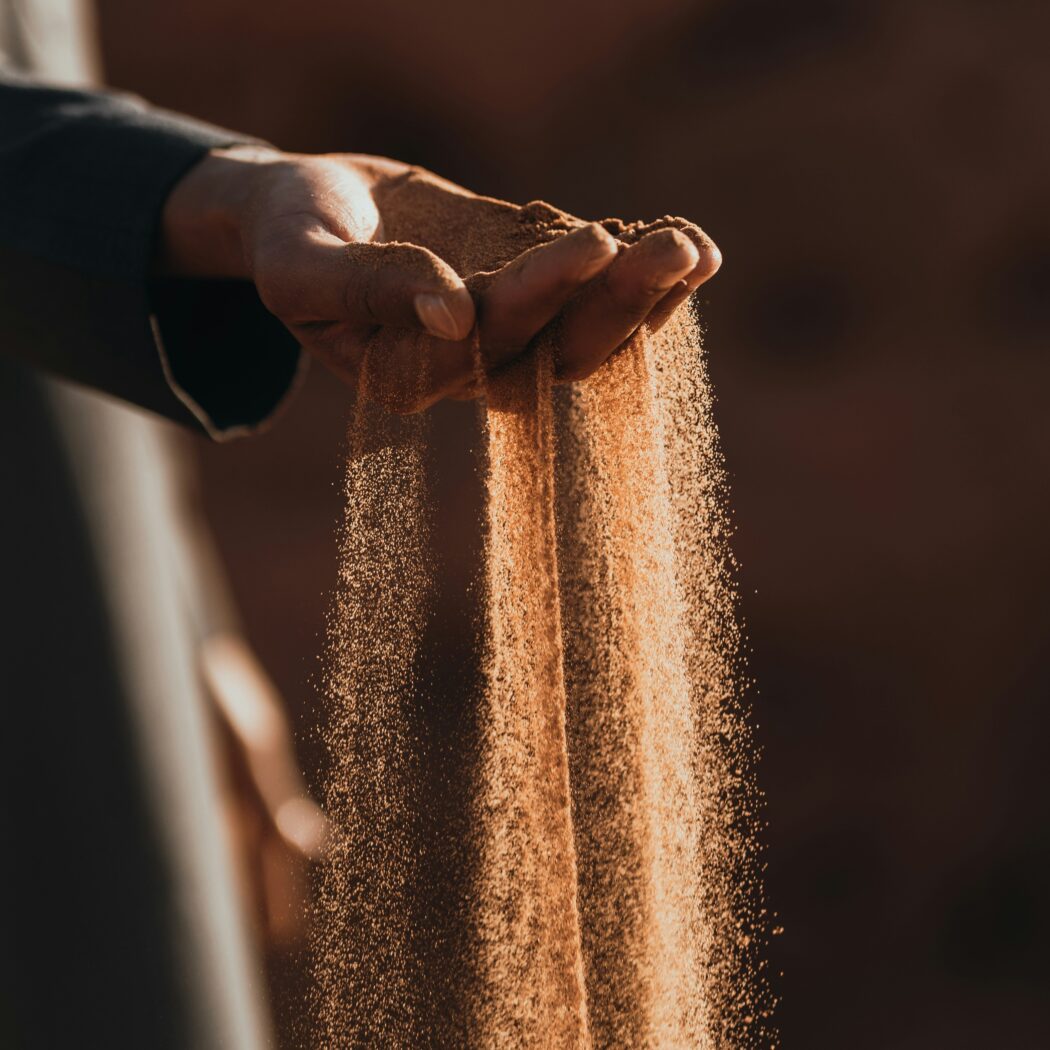
Have you ever picked up sand only to realize how quickly it disappears? As children, we watched it slip through our fingers or fall through an hourglass without understanding what vanishing meant. Sand feels light and abundant, impossible to hold, and its market power mirrors this perceived triviality. The more we clutch what seems infinite, the faster it erodes.
Today, sand is one of the world’s most exploited natural resources, a reality that has quietly taken on geopolitical weight.
The United Nations Environment Programme warns that sand mining is now “one of the major sustainability challenges of the 21st century.”
Second to water in global use, sand saturates modern life in ways we barely register. It is woven into our cities and daily lives: the concrete in our buildings, the glass in our windows, the silicon in our screens. Without sand, there would be no Montreal skyline, no highways, no devices mediating our attention. We stare at it constantly without noticing.
However, abundance is not durability. Beaches, riverbeds, and lakeshores are vanishing under accelerating extraction. Sand takes centuries to form and seconds to remove. Researchers warn that we are rapidly approaching the point at which the demand for natural sand and gravel will exceed the rate of natural renewal. This demand has become increasingly concentrated in rapidly developing regions. Over the past century, sand consumption, closely linked to economic growth, has shifted spatially, with most now in the Global South, especially China and India. What many still view as a cheap, endless resource has become a quiet driver of geopolitical tension.
In parts of India, Kenya, and Southeast Asia “sand mafias” control riverbanks and coastlines, stripping ecosystems and undermining state authority. Economists predict that we will encounter increased prices and a peak production followed by a prolonged plateau, indicating a future of soft scarcity, a dynamic that only intensifies these extractive pressures. The more valuable sand becomes, the harder it is for governments to hold onto it, just as no one can hold all the grains in their hands.
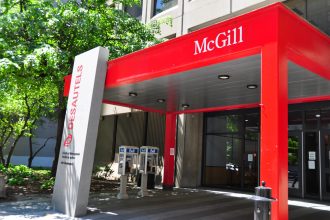
Even Montreal’s ceaseless construction boom is tied to this global sand crisis. Much of the province’s building sector depends on imported sand, meaning that many of the condos and poured foundations are connected to environmental strain elsewhere. What appears locally stable rests on instability far beyond Canada’s borders.
As empires once eroded, so do coastlines today, grain by grain.
We build skyscrapers as declarations of permanence, yet their foundations rest on a material defined by impermanence.
The hourglass of sand keeps turning: it measures time, yet slips regardless of human will. This tension between limitless growth and finite materials is the crux of the global sand crisis.
Sand’s abundance, however, is a matter of distance and scale. Spread across a vast shoreline or scattered through a riverbed following a drought, its appearance seems inexhaustible, blending our world’s geography. Yet once gathered, measured, and transported, its nature changes. What seemed permanent becomes fragile; what seemed infinite becomes finite. Even language encodes this assumption of excess. In French, le sable is grammatically an uncountable noun, treated as a substance too abundant to enumerate. We do not speak of sands, but of sand as a whole. That linguistic certainty now feels ironic, given how carefully each grain is contested. A handful of sand resists containment, slipping through even the tightest grip. At a global scale, economies treat sand as a resource to be stockpiled and consumed rather than sustained. Scarcity then emerges abruptly when systems of abundance cross ecological threshold they were never designed to recognize.
As children, we believed sand was infinite. We believed time was, too. Only later do we learn that both run out.
The grains that once slipped through our fingers echo governments’ inability to contain extraction and cities’ insistence on expanding indefinitely.
Ultimately, the challenge remains: How do we balance aspirations for economic growth with environmental stability before the last grains fall?