
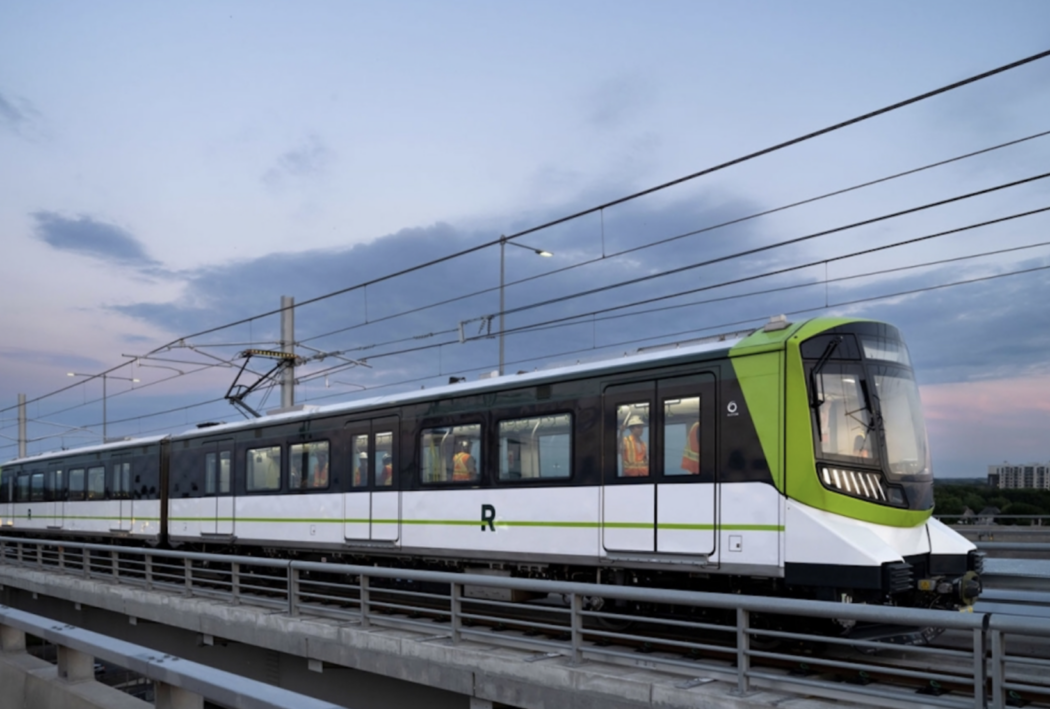
Montreal’s public transportation system is often considered to be one of the best in the world, frequently praised by users for its accessibility, safety, and sustainability. The newest addition to the network is the Réseau Express Métropolitain (REM): a completely automated light rail metro whose line travels between Deux-Montagnes and Brossard with stops along the north end of the island, Mont-Royal, the McGill and Université de Montréal campuses, and Central Station.
Since its opening on November 17th, 2025, the REM has been an absolute gamechanger for McGill’s commuter students travelling east to campus. Commuters from the West-Island, whose trips would typically be at least an hour and a half by the bus and metro, are now just 25 minutes from the Pierrefonds-Roxboro station, doing wonders for efficiency and convenience. But Montreal winters are harsh and unforgiving, and the REM has proven to be no exception against facing the icy obstacles it presents. While a few stations downtown are underground, the rest are outside on viaducts, leading to frequent service interruptions since the start of winter that have caused an uproar among REM users.
The transit lobby group Trajectoire Québec has reported that since the REM’s opening, there has been an average of one breakdown every four days lasting at least 20 minutes. These frequent interruptions greatly inconvenience the REM’s approximate 24,000 daily users, a significant portion of whom are McGill commuters. “It’s been really frustrating having to deal with so many breakdowns…all the commuters thought the REM opening would make our lives so much easier, I had a lot of hope for it, but if anything it’s just making the commute longer and more complicated since we have to scramble to get to campus after it shuts down,” said a McGill commuter from Pierrefonds, a West-Island municipality. Many other REM users share this indignation; Trajectoire Québec released a statement calling for improvements in the service and communication offered by the REM, as well as the enhancement of backup plans in the case of interruption, such as increasing the amount of shuttle buses and parallel STM services.
The company behind the REM, Alstom Canada, has publicly recognized the system’s problematic volatility: “As the train supplier, Alstom acknowledges that the REM has not yet delivered the level of reliability that passengers have a right to expect.” They have identified the sources of the interruptions as “primarily related to the sealing of electronic elements.” Pulsar, the operator of the REM, has also said that there have been malfunctions due to excessive snow getting into the wheel components, causing mechanical failure. Both Alstom and Pulsar are working together to increase the quality of service on the REM, stating that their top priority is to “provide reliable, frequent, and efficient service to users as quickly as possible,” as Alstom put it.
Despite the REM’s poor track record so far, many remain hopeful that these are only bumps in the road, and the appropriate modifications will be made to make the REM a flawless system suited for Montreal’s environmental conditions. For now, the REM remains a case of high risk but high reward. It’s a daily gamble whether an interruption will occur, but when its operation is normal it significantly reduces and simplifies the commute to downtown. Another two lines are set to open soon, with the l’Anse-à-l’Orme branch’s opening scheduled for the coming spring. While the REM may currently fall short of its promise, if the underlying issues are addressed it has the power to completely revolutionize public transportation in Montreal.