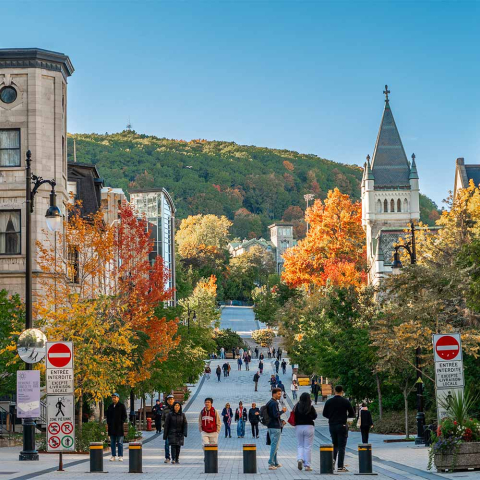
When you step through the gates of McGill University, English is likely to be the language you hear most, which makes sense for an anglophone university in the heart of Montréal. But step outside the Roddick Gates, and language becomes more than a means of communication. In Québec, it’s a political question.
Since the introduction of Bill 22 and Bill 101 in the early seventies, the Québec government has pushed for stronger French language laws to preserve French culture. In June 2026, the government of Québec reached a new eight-year agreement with the province’s English-language universities. A CBC article explained that the deal allocates up to $20 million annually in provincial funding to support French-language instruction and related programs. In return, the provincial government expects about 60% of out-of-province students in undergraduate programs at McGill, Concordia and Bishop’s to have basic French-speaking skills by graduation. If the universities fall short, they will face a financial penalty of $1,500 for each student who falls below the threshold. With implementation beginning this fall, the incoming class of 2030 will be the first to graduate under these requirements.
…[T]he issue is not simply about learning French, but rather how provincial language policy could shape their university experience, post-grad opportunities, and the overall appeal of studying in Montréal.
Questions surrounding efforts to preserve French in the province are especially significant following the Parti Québécois’ recent electoral victory. While the election has not changed the agreement with Anglophone universities, it has brought forth renewed attention to the government’s preservation of the French language. For McGill students, the issue is not simply about learning French, but rather how provincial language policy could shape their university experience, post-grad opportunities, and the overall appeal of studying in Montréal.
Many on campus are still unaware of the new language requirements and McGill’s agreement with the provincial government. In an interview with The Bull & Bear, a U1 student from New York City, who described her French as elementary, said she had not expected to learn French as part of her McGill experience. She argued that requiring out-of-province students to take French courses could make it harder to fit other required classes into already packed schedules, calling the agreement an “unnecessary burden on non-French speakers.”
“There are a lot of cultural elements that [one could] miss out on by not speaking French.”
A U2 student from Ontario offered a different perspective. Fully bilingual, she supports encouraging students to learn French, arguing for the requirement as “there are a lot of cultural elements that [one could] miss out on by not speaking French” and that refusing to speak the language “promotes a culture of gentrification.” However, she also acknowledged that strict requirements could discourage prospective students from choosing McGill, which could potentially pose a financial threat to the university.
For McGill students, the question is not simply whether learning French is valuable, but rather how the university can make it more accessible. Whether the agreement helps students connect with Montréal beyond the McGill bubble or simply becomes another source of frustration will depend on the resources and flexibility McGill is willing to provide.