
I.
Last Friday at Players Theatre, I sat through what turned out to be the most disastrous theater production I have ever witnessed. The Murder at Haversham Manor is the directorial debut of the bumbling, goodhearted Chris (played by Naomi Decker); a one-act play produced—God knows how—by the chronically under-funded, under-staffed, ill-prepared, and poorly managed Cornley Polytechnic Drama Society.
I am not sure where to start with the Drama Society’s series of unpardonable crimes against the Theatre. The production falls so far below “industry standards” that even invoking that term feels uncalled for and cruel. It was not a promising start to see Annie the Stage Manager (played by Gemma Brie), in full view of the pre-show audience filing into their seats, wrestle hysterically with the set’s drooping mantelpiece to drill it back into place. (She did not succeed in time, resulting in a sort of Chekov’s mantlepiece). Neither could I believe my eyes when Florence Colleymoore (played by Laren Hodgins) was knocked out cold by the over-enthusiastic opening of a stage door, carried limp to the stage window, and delivered off stage while the play’s events continued around her.
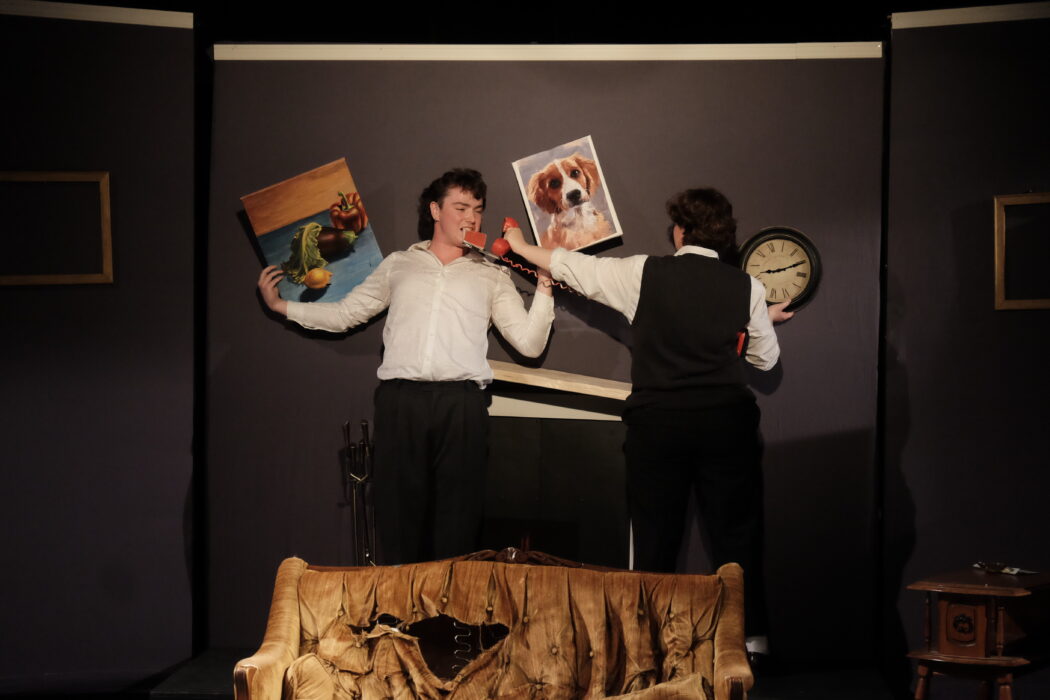
A predictable enough locked-room whodunit, The Murder at Haversahm Manor takes on the untimely death of Charles Haversham (played by Luca McAndrew), which of course reeks of foul play. And it never stops reeking. Each time the word murder is pronounced ( . . . MURDER . . . ) the lights turn red, and the characters perform a cartoonish crouch-squint-swivel motion for the length of a gothic organ refrain. As if that were not pastiche enough, the setting is an English country manor—by turns caricatured to high heavens and butchered beyond recognition (over the mantelpiece hangs a stock-photo print of a dog, a painted assemblage of garden vegetables, and a clock that seems pulled from my third-grade classroom). Really, the visual dissonance is so astounding I almost ought to commend it.
Never was the phrase “hilarity ensued” more in order than for the production of this meta-theatrical rigamarole.
The situation is exactly as expected. On the night of a party celebrating Charles’ engagement to the fluttery and alleged-Hysteric Florence Colleymoore (played by Lauren Hodgins). There is Charles’ imperturbable butler, Perkins (played by Bennett Samberg), and the main-ish personage Thomas Colleymoore (played by Shea McDonnell), a blustery old school friend of Charles’ and the brother of his fiancée. Rounding out the cast is the much animated Cecil Haversham (played by Elias Luz), Charles’ brother and Florence’s lover. Enter: Inspector Carter (played by Naomi Decker), a surprisingly charming off-brand Sherlock called to investigate the . . . MURDER . . . at Haversham Manor.
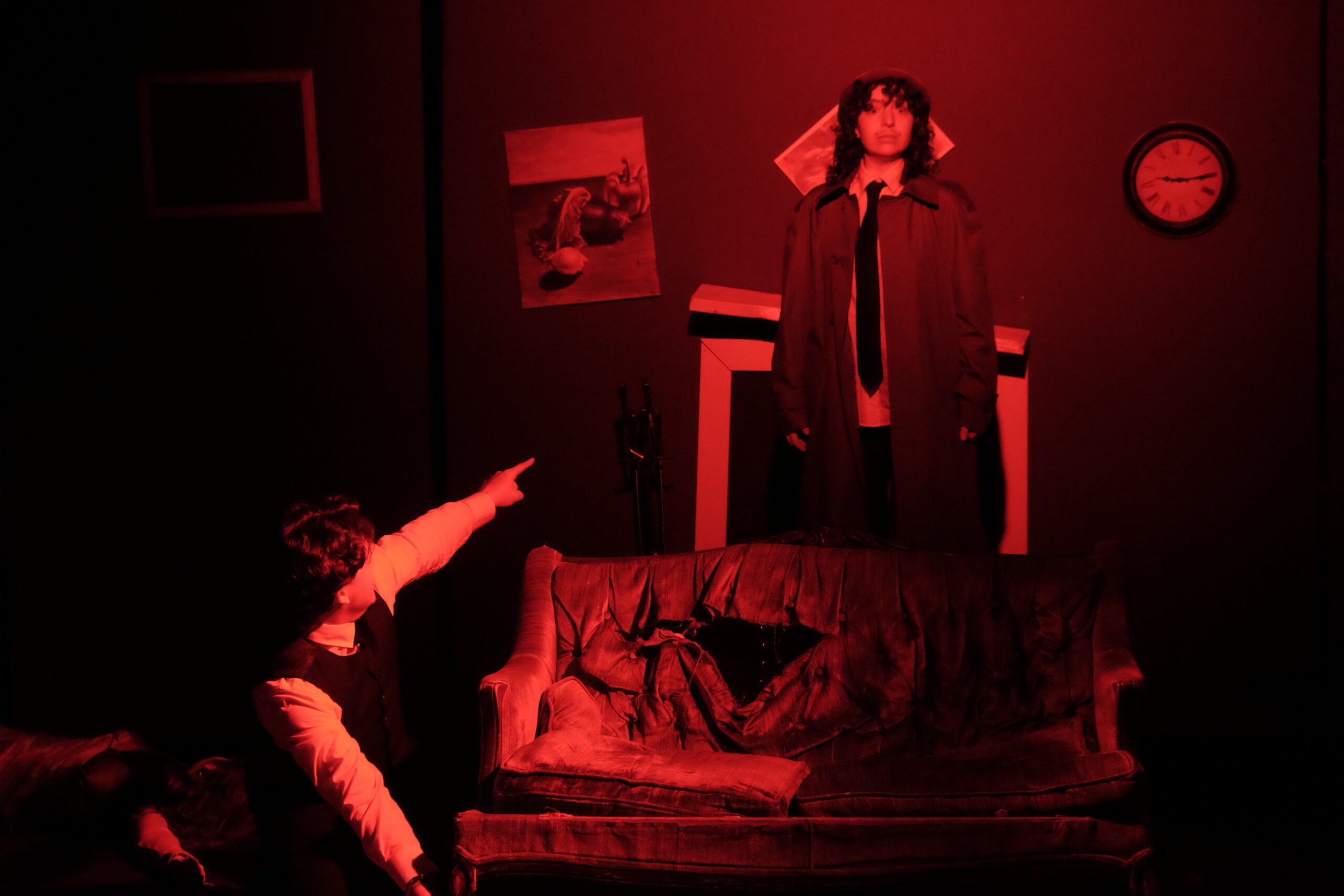
Inspector Carter (Naomi Decker) and Perkins freeze at the mention of . . . MURDER . . . ! Photo credits: Shirly Lu
But I would be remiss not to also acknowledge each of the actors’ impromptu and need-driven efforts as emergency stagehands, as well as Annie the Stage Manager’s impromptu and need-driven effort as an emergency actress. When I say that Annie stole the show, I am not speaking figuratively. With Florence’s red satin dress pulled over her jeans, sneakers, layered long-sleeve and tee, Annie reads out lines (and her stage directions, to boot) from a pink-duotanged script, gradually overcoming her crushing stage fright. But as the actress formerly portraying Florence comes to, a violent battle erupts over who gets to play that role. Yes, a violent battle erupts on stage, and the play keeps stumbling on. But by this point, the production has already offended every last scrap of decorum, so it does not matter all that much.
If any of Haversham Manor’s cast and crew are crazy or masochistic enough to return to the theatre after publicly humiliating themselves for seventy minutes, I wish them well. If they ever manage a half-decent production, I will not be around to see it. If my editor should assign them to anyone ever again, it will certainly not be to me.
II.
But of course, I also witnessed a terrific production last Friday at Players’ Theatre directed not by the bumbling Chris, but by the talented and witty Odessa Rontogiannis. Unlike the butchered play it contains, The One-Act Play That Goes Wrong was a masterful chronicle of the doomed performance of Haversham Manor by the comically inept cast and crew of Cornley Polytechnic Drama Society. Never was the phrase “hilarity ensued” more in order than for this production of the meta-theatrical rigamarole written by Johnathan Sayer, Henry Lewis, and Henry Shields. It is a rare thing for a theatre audience to devolve into uncontrollable laughter, and The One Act Play earns that distinction. Near the end, it was clear that a vocal few were on the verge of tears.
After the cast took their bows, I turned to my friend and fellow theatregoer and said: I think that was the most fun I have ever had at a student theatre production.
How exactly did the cast and crew bring the crowd to such a riotous peak? Despite the show’s devolution into chaos, it is clear that the cast took great effort to make the mishaps look, well, effortless. As Rontogiannis mentions in the program, “making things look like they are falling apart is deceptively difficult”—with a mind for the charming idiosyncrasies of each character. For instance, Naomi Decker understands Inspector Carter sleuthing as a seriously corporeal affair. Her lines of inquiry actually slink around the stage, with feline leaps and elven prances punctuating the eternal question mark her character’s posture poses. Likewise, Shea McDonald, who is apparently used to playing “authoritative male roles,” really got “to ham it up” with Thomas Colleymoore, according to the show’s program. With booming bluster and mock-stoic bravado, his of deadpan estatemanship was a stand out performance if ever there was one.
What I appreciated most was the palpable affection I sensed between cast members. Not only was each performer funny in their own right, but they seemed to find each other funny, which made me feel like they were—generously!—letting the audience in on a well-oiled inside joke. If I can use the word synergy without my reader rolling their eyes, the cast of The One-Act Play had it in spades.
Finally, I cannot neglect the absurdly inappropriate set design by Caitlyn Davis and wonderfully benign props courtesy of Production Manager, Solène Chevallier. The drooping mantelpiece looks innocuous, and the framed photographs could not be more random—and appearing random is a much trickier feat than being random.
In lesser hands, a play about failure would not have been the success that The One-Act Play That Goes Wrong undeniably was. After the cast took their bows, I turned to my friend and fellow theatregoer and said: I think that was the most fun I have ever had at a student theatre production. She was in full agreement. I walked home—the bus wasn’t running—thinking about what fun farce is when it’s well done.