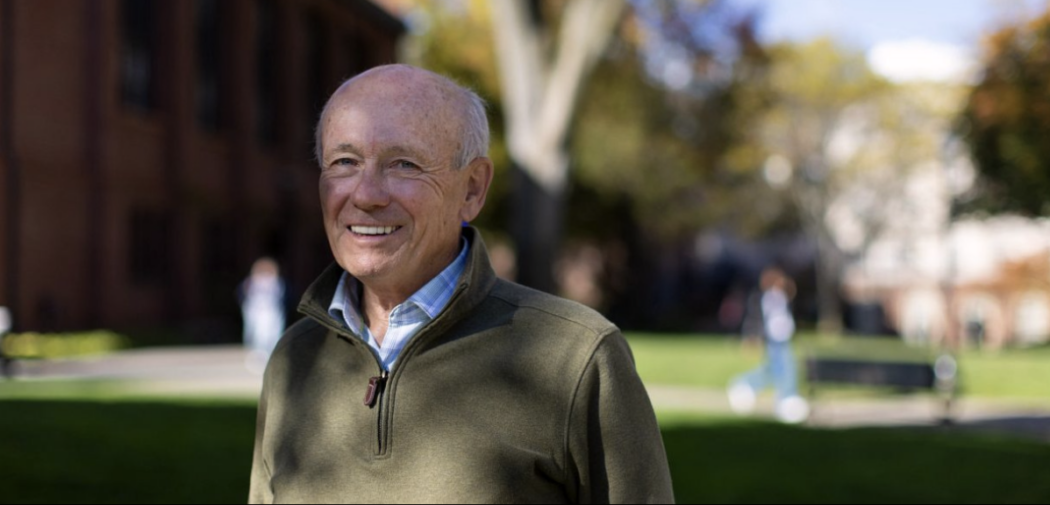
Back in October, an email was sent out to McGill students about an alumnus, Dr. Peter Howitt, who won the 2025 Nobel Prize in Economics. I looked him up and thought it was pretty cool to know he had been here. I then started as a staff writer for the Business and Economy section, and figured it wouldn’t hurt to see if he would be willing to talk to me about his time here and his prize. Nearly three weeks passed, during which I accepted that the answer was no, but then I heard back. I frantically started doing my research and scheduled a time to meet with Howitt. We ended up having a great conversation. Here is what we talked about:
What was your time at McGill like?
“My social life there was centered around Molson Hall. Many years later, my daughter ended up going to McGill, and she also went to Molson Hall. But when I was in Molson Hall, if a woman had been found there, then someone was going to get expelled. So things have changed quite a bit. [McGill] was my introduction to the big city, coming from a small city in Ontario. I remember loving Montreal, remember loving the view from up the hill. “
Howitt knew he wanted to study economics prior to university, but said that McGill was where he “learned to love economics”.
What were your most memorable classes or lectures?
“I remember probably my most inspiring lecture was not in economics. It was Charles Taylor, who taught political philosophy. He was a young man then, and he would walk into the classroom, up on the podium with his robes flowing behind him. It was standing room only in the lecture hall whenever it was in Leacock. It was such an eloquent lecture. People just hung on his every word. I also remember taking lectures from Donald Hebb, who is in psychology, and he’s now recognized as, I guess you call him the great grandfather of artificial intelligence. He is the inventor of the concept of a neural network.”
What made you want to continue to study economics?
“My eyes were most opened in my final year, when we had the fourth year honours seminar…It was in that honours seminar that I really got hooked on macro economics and because of that I decided I probably wanted to become an economist.”
After graduating from McGill, Howitt got his master’s from the University of Western Ontario in 1969, and then his PhD from Northwestern University in 1973. After leaving Northwestern, Howitt went back to Western to teach, where he later took a sabbatical to the Massachusetts Institute of Technology to be a visiting professor. It was here that Howitt met Philippe Aghion, with whom he created the mathematical model for Creative Destruction, the work that eventually won them the 2025 Nobel Prize in Economics.
How would you describe Creative Destruction to someone without a background in economics?
“Economies grow through technological change that comes with these waves of innovation that bring in all sorts of new products and processes, but sweep aside the old order, constantly disrupting things. And so old things become obsolete, and people who have businesses producing the old things go broke and skills that were tied to the old technology might find that they’re devalued and they suffer, but the vast majority of people benefit from this, but the consumers have a bigger variety of less expensive and more interesting products than they used to have.”
How did you first learn about Creative Destruction?
”I remember being assigned a paper by Mirrlees and Kaldor on the subject of obsolescence in math theory. I remember it being very difficult. It was full of more integrals than I’d ever seen in my life, and I had a lot of trouble understanding it. I never really thought about that until fairly recently, about what is the connection between McGill and my work on creative destruction. Obsolescence is really just sort of a clinical, less colorful term for creative destruction, so I was introduced to it at McGill, but I didn’t really give it a lot of thought.”
What made you revisit this idea of Creative Destruction?
“I met this fellow, Philip Aghion, who was just a beginning assistant professor [at MIT] at the time, and we started talking. And one thing sort of led to another. He started asking, you know, he was not a macro economist, but he’d heard of this concept of creative destruction. Everybody had heard of it at the time, but it just nobody had managed to put it into a model that we would teach students, either undergraduate or graduate…we managed to cobble this together, and it was a big hit with everybody everywhere we went to present it. So we kept working on it, started looking at some data and trying to test different hypotheses and measure things.”
Did you ever consider the possibility of receiving a Nobel Prize from this work?
“When Phillippe and I produced our first paper, we realized we were onto something important. We got very favorable reception from seminars and conferences where we went to present the paper, and we continued to work on the subject, and we seem to be making lots of progress getting things published in top journals. People were citing us a lot. We produced a couple of books that became pretty popular, and people started talking about us as candidates for the Nobel Prize. But this was, you know, 20 or 30 years ago we’re talking about…Eventually I thought, okay, well, it would be very nice to get a Nobel Prize, but people are living satisfying, fulfilling lives without one, that’s fine.”
How did you find out you won the Nobel Prize?
“I knew that the night before that someone was going to get the call the next morning. But I’d actually been up late at night watching the Blue Jays play a baseball game on television and twiddling with my phone between innings. By the time it was over, it was quite late, and I didn’t want to disturb my wife going back to bed so I didn’t bother to plug the phone back in and it was dead. So I didn’t actually get the call directly. What happened was my wife’s phone kept ringing at 6:15 in the morning, even though she had Do Not Disturb turned on. Finally, I said, “Well, you better answer. I mean, whoever it is, they’re just going to keep ringing.” It turned out not to be the Royal Academy in Stockholm, but a very enterprising Scandinavian journalist who had managed to get Pat’s number and called, and said “I’m calling to congratulate Peter Howitt on winning the Nobel Prize.”
The winners for the prize were announced in mid-October, but the ceremony wasn’t until December 10. This made for a hectic couple of months for Howitt, as he was flooded with newfound fame and attention. “It was very hectic, confusing, bewildering, strange, and exhilarating,” he said. He recalled being asked for autographs upon arriving in Stockholm. “Professors just aren’t used to that,” he said.
Has being a Nobel Prize winner brought you back into the economic sphere?
After teaching at Western, Howitt was a professor at The Ohio State University in 1996 and then at Brown University in 2000, where he stayed until retiring in 2013. Howitt now lives in North Carolina with his wife, where he still dabbles in economics but says he spends more time playing golf.”
“I haven’t played much golf since October the 13th. I’m not going to get back into economics the way I was when Phillippe and I were at our peak. I’m not a young man anymore, I’ve got to admit that it’s time for the next generation to come and replace us, as I’m sure they will. But nevertheless the invitations have been so numerous and irresistible that I find that I’m enjoying it, even though I’m not really doing original economics anymore, just sort of describing what I’ve done over my career and how I think about it now. People seem to be eager to hear about it and I’m enjoying talking about it.”
Howitt will be visiting Northwestern and Western, and has already been back to Brown since receiving the prize. He will also visit McGill in October.
How does AI fit into your Creative Destruction model?
“I’ve learned to never be surprised by technology…We’ve seen things that are somewhat similar, we’ve written about these things, about what we call general purpose technologies that really revolutionize not just one industry, but a whole set of industries and change people’s lives. The steam engine was one of them, really was kind of at the heart of the industrial revolution that involved a tremendous amount of creative destruction. The electrification that started in the last third of the 19th century and continued on, was another general purpose technology. When they first arrive, people are just amazed at their potential, particularly at their potential for replacing human intelligence. And a lot of people predict that this is going to spell unemployment for generations, spell low wages for generations, because how can you compete against the machine that just needs to be oiled once in a while. But those predictions have, so far, always turned out to be quite wrong, quite misleading…What happens is that people make further discoveries that open up a lot of the potential of the new general purpose technology that ends up providing new jobs, new rules that had never been thought of before, and they make people’s lives much richer…What [AI] is going to do is make people a lot more productive.”
It was truly an honor to speak with Dr. Howitt. I greatly enjoyed hearing about his time at McGill and the seeds it planted for his incredible work later on.