Discrepancies in rights to housing, healthcare and education are not new injustices for Indigenous Peoples; they are the legacies of centuries of displacement and genocide enforced by legal and religious colonial frameworks, such as the Doctrine of Disocery created in 1493. The Doctrine declared that non-Christian territories ought to be colonized because European colonizers perceived Indigenous peoples as “less than human.” Over time, the dehumanizing process of colonialism became embedded in law and systematically prioritized White settlers’ control and power over land.
In 2025, Montreal recorded having 4690 homeless people in the city. Indigenous Peoples represent 13 per cent of the city’s growing homeless population, while only making up 0.6 per cent of Montreal’s whole population. The overrepresentation of First Nations experiencing homelessness is a result of the endurance of colonial mechanisms of dispossession and expropriation. Colonial and neo-colonial systems have continuously produced discriminatory policies and criminalization restricting access to education, employment and more. The overlapping systems of oppression produce harm across generations, which results in Indigenous homelessness as a cumulative effect of colonial policies rather than a monolithic condition or isolated circumstance.
Located in the downtown area, Cabot Square, named after John Cabot, is a powerful example of this reality. Although it was once an integral part of Indigenous trade routes, settlers have adapted the square over time to erase Indigenous presence. Cabot Square has been consistently dehistoricized and depoliticized for the wellbeing and comfort of middle class white communities. The Doctrine of Discovery provided the deeply colonial social framework through which the ongoing displacement and disempowerment of Indigenous Peoples became possible.
The Doctrine of Discovery
In the fifteenth century, a set of formal statements written by Popes, known as papal bulls, gave Christian colonizers the authority to invade and claim non-Christian lands and their resources. The Doctrine of Discovery became one of the foundational legal and moral frameworks behind European colonization on Turtle Island, laying the foundations for the dispossession and exploitation of sovereign Indigenous lands. Colonizers would also apply the concept of Terra Nullius – the idea that non-Christianized land was ‘empty’ – to support the Doctrine of Discovery. Treating the land as vacant was integral to the colonial framework enabling Indigenous land dispossession and legitimizing colonial expansion.
This logic is materialized in urban spaces like Cabot Square. The land was originally inhabited by the St. Lawrence Iroquoians until the late 1500s. The site, near Mount Royal and the St. Lawrence River, then became a trading place for other Indigenous nations such as the Mohawk, Cree, Iroquois and more. The City of Montreal purchased the site from the Sulpician order in 1870 and converted it into a public park, known as Western Square. During the 1960s, the area around Cabot Square transformed into an extremely lucrative commercial and transactional hub. However, the area saw a decline in settler economic activity over the last half-century, which marked the beginning of a slow reclamation of the site by Indigenous Peoples.
Cabot square: A Meeting Place for Indigenous Peoples
Mary Graham’s work on Indigenous legal frameworks displays how relational balance between people, land, and other-than-human life – along with one’s obligations towards them – are essential to “proper conduct.” In her framework, land is not a resource but the source of Law itself: The primary relation that grounds others and establishes custodial responsibilities. Therefore, proper conduct does not describe an individual moral rule but an entire relational system where caring for country and kin are inseparable. It is the ongoing maintenance of these obligations that keep the balance within the social and natural world. This understanding directly contrasts with the Doctrine’s assumptions that good governance ought to establish hierarchy through rigid control.
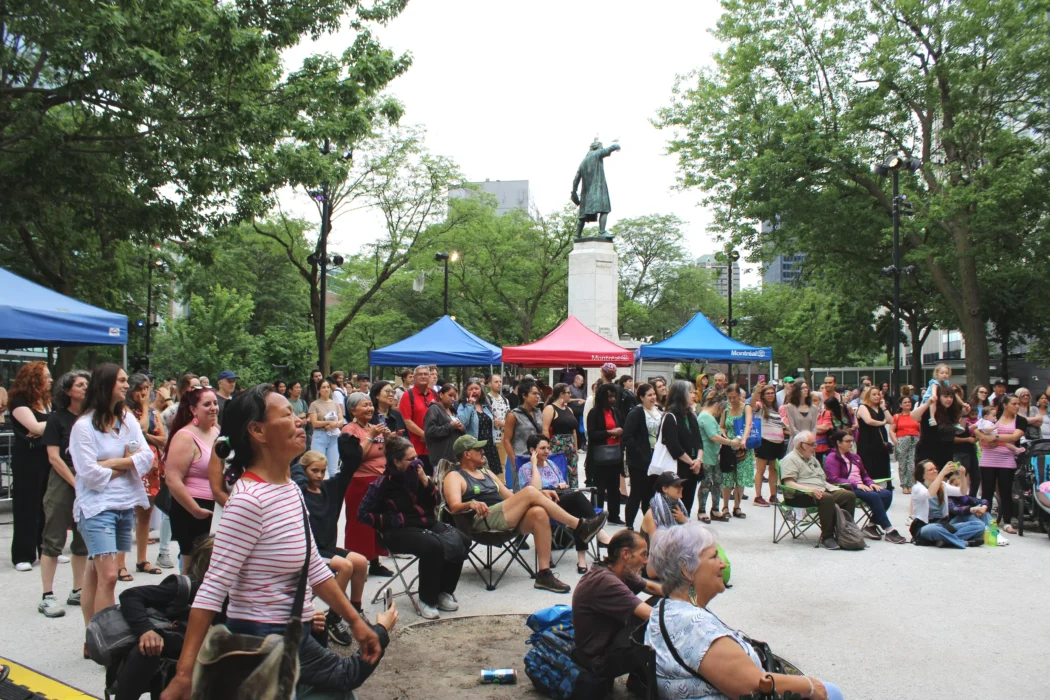
Relational understanding of governance that disengage the settler state’s claims to define and categorize Indigenous Peoples are visible within Indigenous urban spaces. Cabot Square, for example, now functions as a meeting place for First Nations, Inuit and Métis Peoples in Montreal, working as a powerful symbol of Indigenous resilience and resistance to colonial erasure. Today, the Square can be interpreted as a “Native Hub,” a concept introduced by Renya Ramirez and Laverne Roberts in their work on Indigenous urban communities in California. Ramirez presents the hub as a place for Indigenous Peoples to maintain and strengthen relationships, asserting that the “hub offers a mechanism to support Native notions of culture, community, identity, and belonging away from tribal land bases.”
While Cabot Square serves as a space of resistance, it is also a site where colonial legacies are reckoned with and mourned. For example, a memorial was held in the Square last June to commemorate the lives of the thirty three homeless people who passed away in the last three years, half of whom were Indigenous women. This public display of grief was also communicating broader grievances surrounding limited access to essential services and the forced displacement of communities that have been affected by the settler colonial system.
The urgency to hold the settler colonial state accountable for the systemic disenfranchisement of Indigenous Peoples is apparent with the creation of Mitshuap. This Indigenous-run shelter was created after an Innu man died on a freezing night when he was turned away from multiple shelters. As an overnight emergency shelter, Mitshuap provides immediate warmth and refuge to 51 people in need. It displays how Indigenous communities are mobilized by a shared responsibility to meet urgent needs that municipal shelters often don’t have the capacity to meet.
Gentrification in Cabot Square
In 2011, the borough of Ville-Marie and the Programme Particulier d’Urbanisme (PPU) planned to revitalize Cabot Square and enhance the heritage site. The five-million-dollar revitalization plan included initiatives to make the space ‘greener’ and create more affordable housing in the area in order to attract middle-class, and commercial development. While these measures were framed as efforts to revitalize the space, they were implicitly catered towards certain groups of people. The plan overlooked individuals – many being Indigenous – who used the space as a gathering place and temporary home. A brief submitted by the Montreal Urban Aboriginal Strategy Network warned that the changes would likely result in the “continued displacement of Indigenous Peoples.”
Gentrification actively constructs Indigenous presence as a security problem. In recent years, Cabot Square has been increasingly surveilled, as police patrols have become a regular occurrence in the area. Today, some business owners near Cabot Square argue that crime and safety concerns have increased since the start of COVID-19. Some are strong advocates for increased police presence arguing that more policing will restore public order and diminish crime. However, the intensified surveillance and patrolling disproportionately targets Indigenous Peoples, rendering them more vulnerable to criminalization, violence and displacement.
A deeply colonial logic undergrids the so-called revitalization of urban areas such as Cabot Square. Under the guise of modernity and improvement, Cabot Square, a reclaimed site of gathering and resistance, is again being taken away from Indigenous communities. The tumultuous evolution of Cabot Square, from a site of trade to a meeting place for Indigenous communities, effectively reflects how colonial legacies continue to shape Montreal’s urban development.