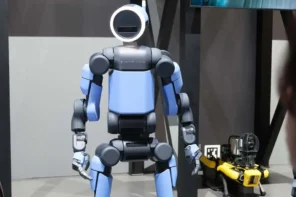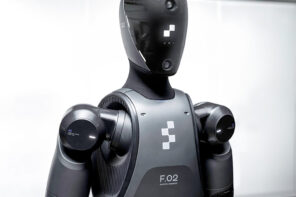
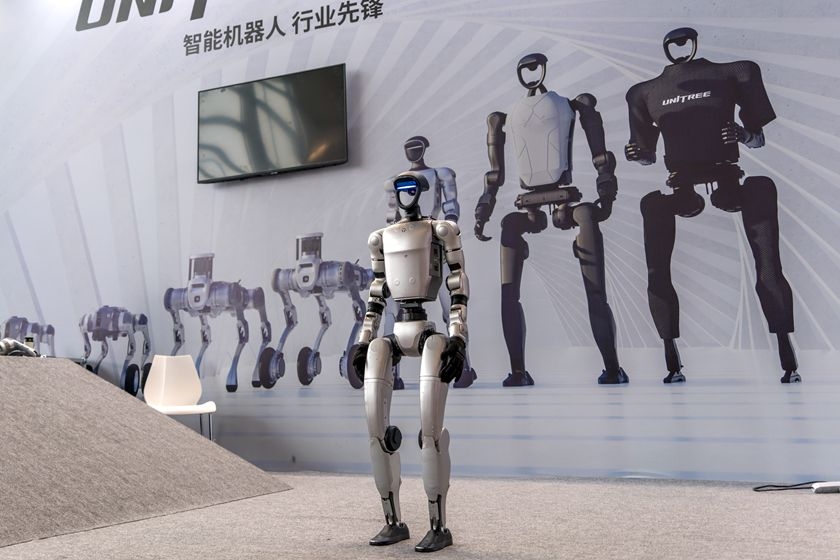
At China’s 2026 Spring Festival Gala, hundreds of millions watched humanoid robots perform flips, kung fu routines, and balancing acts, moving with near-human-level precision. What appeared to be entertainment was, in reality, something more strategic: a demonstration of power and technological advancement. The performance showed that the global competition in artificial intelligence is not confined to software, but also extends to the physical world.
A new arms race has begun, and it is being fought with robots.
What is most apparent is the difference from last year’s Spring Festival. The 2025 Gala also featured robots, but they were significantly less advanced, performing simpler movements like twirling handkerchiefs, walking, and kicking. The speed of that progress is precisely what makes China’s robotic push so significant. In just one year, these machines have evolved from simple performers into systems capable of complex coordination. That kind of advancement is not accidental; it reflects a broader national strategy to accelerate development through scale, testing, and deployment. Out of around 15,000 installations of humanoid robots, China accounted for more than 85%, while the U.S. represented only 13%. China is not building these robots for spectacle alone, but with the goal of integrating them into factories. In a sense, the Gala was not only a show, but also a preview of the future: the same machines that entertain today are being trained to work tomorrow.
Despite the lead China’s lead, the U.S. is not out of the race. China has an oversaturation of humanoid robot startups, with over 150 unique companies creating a fierce field of competition. Furthermore, although China’s robots can perform tricks and dances, most are still unable to reliably perform human tasks. While China has an advantage in manufacturing at a scale that cuts costs and a supply chain that outmatches other countries, the U.S. maintains advantages in software and advanced chips, boasting its own set of major players like Tesla and its Optimus robots.
Yet, the true significance of the matter goes beyond innovation or market share; it is increasingly being viewed as a matter of national security.
Weaponized drones are being used at a massive scale in the Russo-Ukrainian War, with Ukraine launching 9,000 drones every day. The trajectory is clear: autonomy is moving from the air to the ground. While today’s humanoid robots struggle with basic industrial tasks, China has demonstrated how fast they can improve. This suggests that future iterations could operate in complex and unpredictable environments. A robot can work fully autonomously in a factory, but with different programming, it can be adapted for surveillance, logistics, and even combat roles.
This raises another question: unlike past arms races, which were dictated by who had the larger stockpile of deadlier nuclear weapons, fighter aircraft, and conventional forces, this competition is driven by data, artificial intelligence, and the speed of integrating humanoid robots into daily life. The country that can most effectively deploy these intelligent machines at scale will hold a significant advantage. That is what China is focusing on, the ability to rapidly manufacture and deploy these machines, whereas the U.S. focuses on software and innovation superiority.
Both countries have their strengths, but the real winner will be the one who can translate these technological breakthroughs into the real world most quickly.