
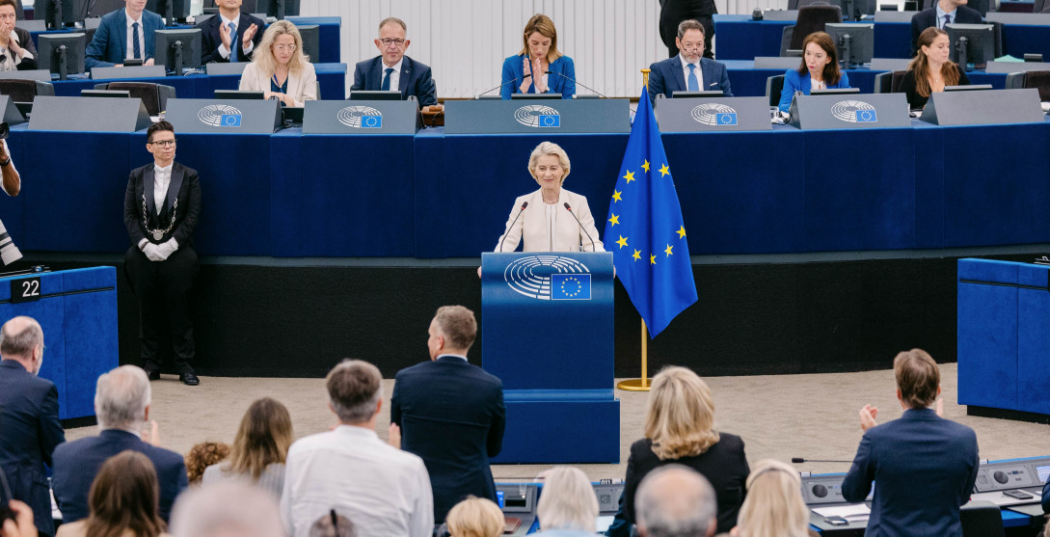
The European Union is preparing to create a status that doesn’t currently exist, and Canada could be the first to hold it. On September 16, European Commission President Ursula von der Leyen gave the EU 2026 State of the Union Address. In her speech, von der Leyen proposed “opening the door for Canada to be the first associate member of the EU.” Crucially, this does not mean Canada is seeking to become a full-fledged member of the EU—nor is it in a position to do so. Carney made it clear that this proposal is a “different framework” for a “unique, positive approach” to mutually beneficial cooperation that would preserve both European and Canadian sovereignty. There is no clear precedent for Canada’s potential EU status, and the exact details of what this membership would entail have yet to be outlined.
Still, Canada and the EU already have a close international relationship. The Canada-European Union Comprehensive Economic and Trade Agreement (CETA) negotiations began in 2009. The agreement was provisionally implemented in 2017, though it has yet to be ratified. The agreement aims to promote labour rights, environmental protection and sustainable development between the two, and eliminates custom duties for exporting businesses.
In the same year as CETA, the European Union also implemented a Strategic Partnership Agreement (SPA) with Canada to “further deepen and broaden bilateral cooperation on a wide range of issues,” according to the Government of Canada’s website. In addition, Canada and the EU signed a Security and Defence Partnership in 2025, further expanding their defence cooperation when Canada became the first non-European country in the Security Action for Europe initiative earlier this year.
Close international cooperation between Canada and the European Union is nothing new. However, the proposed “associate member” status is unique, as it would give Canada a concrete position within the EU, rather than outlining cooperation objectives on specific topics, like previous agreements.
Carney made it clear that this proposal is a “different framework” for a “unique, positive approach” to mutually beneficial cooperation that would preserve both European and Canadian sovereignty.
Furthermore, this partnership carries significant political weight considering the current tariff war between the United States and Canada. President Trump warned reporters that any “bad intentions” from Canada would result in the United States imposing “very serious tariffs” on Europe. Prime Minister Carney responded to Trump’s comments in a press conference, calling the alliance a “positive process,” and adding that “[…] nobody is going to tell us what language we speak […] dictate our culture, or with whom we can strike agreements internationally.” This seems to reference the two countries’ inability to reach a deal earlier this summer, where Carney claimed Trump had made “threats to the French language,” which the president denied.
No matter how unclear, a closer Canadian partnership with the EU while the country is at a standstill with its southern neighbour could exacerbate already-high tensions. That said, the current framework of associate membership is in its early stages. Carney has specified that a Canada-EU summit will take place in Montreal at the end of the month to “drill down the details.” He also mentioned that Canada-EU cooperation could “mutually strengthen strategic autonomy,” corroborating von der Leyen’s emphasis on manufacturing, tech, defence, energy, AI, and economic security.
Carney’s future-focused speech also brought forth interesting implications for both Canadian and EU citizens, particularly for students. Prime Minister Carney stated that through the new alliance, Canada and the EU will aim to deepen ties between their peoples, especially the younger generation, which would allow for “youth to live, work and study where they want on either side of the Atlantic.”
At this time, specific details regarding concrete arrangements have not been disclosed, but Carney did mention the possibility of Canadian students being eligible for participation in the European exchange program Erasmus+. This European initiative allows students and youth to study, work and train abroad by providing grants to cover study and living expenses. The Erasmus+ program is a great way to connect with people from all over the world through a rich and vibrant community of students, as well as gain valuable academic and professional experience abroad. Joining the Erasmus+ programme would give Canadian youth a valuable opportunity to connect with universities, research programs and career options beyond Canadian borders.
Deepening “people to people ties,” as mentioned in Carney’s speech, implies more flexible immigration policies and agreements to accommodate programs such as Erasmus+, and bring Canadian and EU citizens closer together. However, immigration policy in Canada remains tricky, as the provinces are heavily involved in policy-making. Thus, before reaching an agreement that could allow citizens of Canada or the EU to easily move across the Atlantic, Canada would first have to find a consensus among its own provinces.
[I]mmigration policy in Canada remains tricky, as the provinces are heavily involved in policy-making.
Finding common ground among the provinces, especially on matters regarding immigration policies, is not an easy task. On one hand, some provinces, such as Alberta or Quebec, seek to reduce immigration through a more restrictive approach. Alberta demonstrated its will to reduce immigration in its recent referendum, and Quebec’s newly elected provincial government has also made immigration cuts a priority. On the other hand, the Atlantic provinces, Ontario, and British Columbia have a more favourable outlook on immigration, especially through their recognition of the economic benefits that foreign labour brings to the provinces. As a result, whether Canada can adapt to the EU associate member initiative is currently uncertain. That being said, in light of Prime Minister Carney’s historical speech on the international scene, there is a real possibility that the initiative becomes fruitful.
Although much remains uncertain about the role Canada would occupy within the European Union, both Prime Minister Carney and President Von der Leyen have expressed a strong will for an alliance that would bring Canada and the EU closer. This historical potential alliance concerning matters of trade, security, innovation, education, labour and immigration, could further unify the longstanding relationship between both sides of the Atlantic and offer a brighter future for Canadian international relations.