When I was 14, I read Emily Brontë’s Wuthering Heights for the first time, and my life changed forever. Aside from the beautiful prose, Brontë offers a novel with deeply rooted social commentary, which was a rare feat for a woman in the 1840’s. When it initially came out, readers were deeply disturbed by Brontë’s novel. It was pointedly grim both in plot and setting – which readers found to be crude – especially coming from a woman. However, as time passed, Brontë’s disturbing novel came to be appreciated as something more, where her critique of the social structures that defined Victorian England was legitimized. Wuthering Heights is consistently placed on lists such as The Guardian’s “100 Best Novels of All Time,” showing how widely valued it is now, comparable to its release.
When the movie was released (on Valentine’s Day), my best friend begged me to go see it with her. I reluctantly agreed, and on that fateful February 14th, I was met with the most agonizing two hours I’ve ever spent in a Cineplex.
The most common question that arises for a new adaptation is how close the movie has to be to the original text. To this I respond that there is a difference between an adaptation, which would be translating the story from one mode of media to another, and a reimagining, which would be to maintain certain parts of the story, but fundamentally change others.
As a movie claiming to be a direct translation, the Wuthering Heights adaptation is receiving hostility; watchers felt as though Emerald Fennel, the film’s director, had changed the primary story and messaging in order to fulfill her own romantic view of the novel. My issue with the film is not that she changed aspects of the book. Rather, I feel as though she sacrificed the didacticism which fundamentally undermined the novel to fit a gothic aesthetic—that being a romanticization of the gothic period while omitting the problems that existed within it.
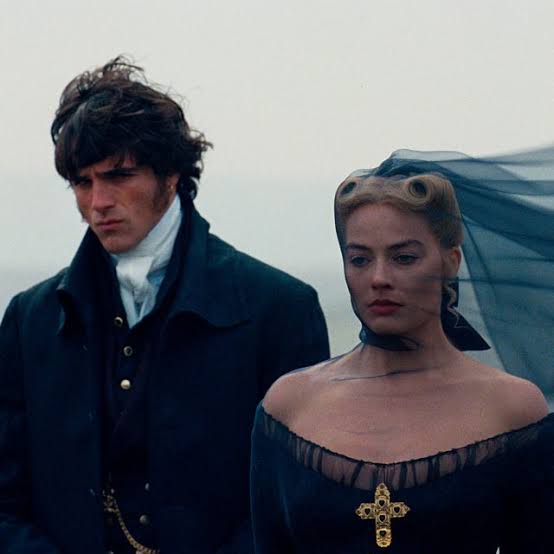
My first problem lies in the age of the primary character, Cathy, who is a teenager in the novel. However, Emerald Fennel cast Margot Robbie, a woman well into her thirties, to play this young girl. This decision to turn Cathy into a fully grown woman has perpetuated the hyper-sexualized nature of the film, which decided to make this a hyper-sexualized rendition of the novel.
The genre of dark romance is very popular in film and television at the moment, likely influencing Fennel’s decision. Around 2020, there was a meteoric rise in the consumption of the dark romance genre, with this genre being mainly promoted to young women. If this were not claiming to be Wuthering Heights, this movie would have gained extreme popularity for its ominous sexual implications. To intentionally sexualize characters who are largely associated with adolescence is a deeply unsettling decision from Fennel, and it distracts from the main issues present in the text. The second half of the novel takes place after Cathy’s untimely death, where she then proceeds to haunt Heathcliff, the boy her family adopted, in their home. She is physically tied to the place and person who brought her so much harm. The film however, ends when she dies, and Heathcliff is there mourning her. Fennel took away approximately half of the novel in order to make this story a clear-cut reference, when Brontë is very clear in her writing of the novel that it is not that. The casting choice for Cathy is directly linked to the hypersexualization within the novel, wherein by making her an adult, Fennel can better fulfill her romantic fantasies of the novel. This however, does not change the fact that Cathy was originally a young girl, who is now placed in a sexual context.
There is also a problem with the casting of Heathcliff, who is played by Jacob Elordi, a white actor. This is an issue because Heathcliff is explicitly not white. The novel’s primary concern are issues regarding class; both in monetary terms and in social hierarchy. The mistreatment Heathcliff faces is due to his ambiguous race, and is further the reason for his low economic status. Cathy’s family essentially adopted Heathcliff when they were children, with her father essentially turning him into a servant, where he proceeds to get severely demeaned by the family. Brontë, was making a social commentary about the problematic social structures that defined much of Victorian England, where class divisions were strict and shaped how individuals were perceived and treated.
We currently live in a period where celebrities in Hollywood like Sydney Sweeney are being rightfully scrutinized for glamourizing eugenics. There is a severe problem with representation in many modern films, and Fennel’s decision to cast a white man to play a person of colour is further perpetuating racist ideology that pervades Hollywood. Wuthering Heights was turned from an intense social commentary on the toxicity of Victorian England to a superfluous dark romance.
These two casting choices completely change the stakes of the novel. It is no longer about the effects class and race disparities have on children, but rather about a taboo romance with no distinct commentary. Wuthering Heights is completely reduced to a Gothic aesthetic that lacks any sort of profound commentary on the characters’ status.
Ultimately, Emerald Fennel has warped Wuthering Heights to an unrecognizable degree, and I was proven utterly correct in my hesitation. The dramatic genre shift and creative decisions that Fennel took upon completely strip the book of what makes it interesting, and turn it into another conventional romance story—or at least something that is meant to seem romantic.