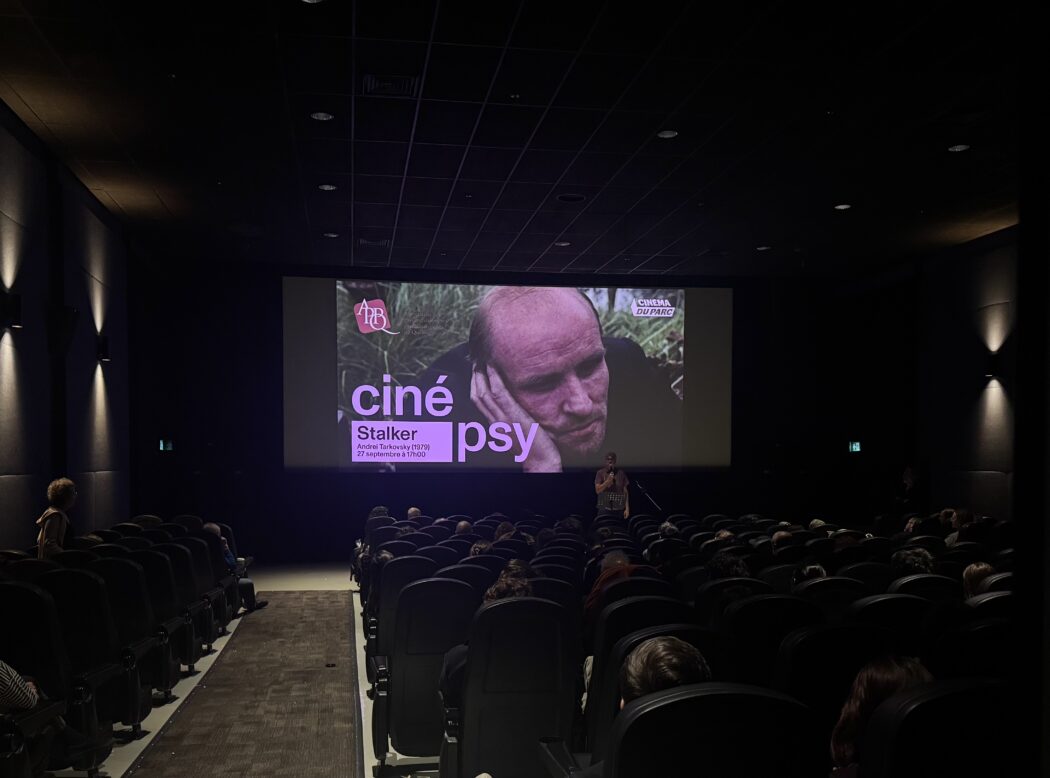
A sold-out screening of the late Soviet director Andrei Tarkovsky’s Stalker (1979) on a languid Sunday in September drew all genres of people: devotees of a cult classic, curious cinephiles, unsuspecting couples, and even… psychotherapists? On September 27th at Cinéma du Parc, CINÉPSY, a series organized by the Association des Psychothérapeutes Psychoanalytiques du Québec (APPQ), invited audiences to explore films through the eyes of health and human sciences practitioners using a psychoanalytic approach.
The evening was divided into three parts: the screening, commentary from psychiatrist and psychoanalyst Prométhéas Constantinides, and an open discussion with the audience. By showing the film first, CINÉPSY purposefully lets the viewers form their own impressions before any interpretation is offered. With a work like Stalker, this intention regarding the viewing experience felt particularly important. Tarkovsky is known for forgoing conventional storytelling in favour of conveying metaphysical themes of self-reflection and spirituality. His 1979 film is no exception to this style—a philosophical and psychological exploration of faith and human nature, built through mesmerizing cinematography, uncanny ambience, and an abundance of reflective monologues.
The film follows three men: a writer, a professor, and their guide, known as the “Stalker,” as they travel through a restricted site known as the “Zone.” Inside the Zone is a room said to fulfill one’s innermost desires. As the men survive the Zone’s many dangers, they discuss what they seek from visiting the Room, gradually confronting a harsh truth about desire: what we long for may not be what we unconsciously desire. This raises a question each of them must answer: should I fulfill desires I am not conscious of and perhaps not willing to accept?
A note for those who haven’t seen the film: the following discusses the film’s central question but not its ending.
This is the kind of question psychoanalysts work with every day, and Constantinides built his commentary around it. He focused on the moment the writer and the professor approach the Room:
“La possibilité même de la réalisation du désir le plus profond crée une tension intolérable pour l’écrivain et le professeur. Ce sont les derniers soubresauts de leur volonté de puissance. Le voile tombe, le manque à être des personnages, leur vide, essentiellement, sera révélé au grand jour…”
(Translation: “The very possibility of fulfilling the deepest desire creates an intolerable tension for the writer and the professor. These are the last convulsions of their will to power. The veil falls, and the characters’ lack of being, their emptiness, essentially, will be revealed in broad daylight…”)
Read this way, the men’s hesitation is not cowardice but a kind of defence. Both have spent the film asserting themselves through intellect and cynicism, and the Room threatens to strip that away. The dread comes from the manque à être, or “lack of being,” a term psychoanalysts use for the fundamental human sense of incompleteness. What we believe about ourselves only scratches the surface, and the unconscious, which psychoanalysts spend their careers helping patients explore, holds the rest. To step into the Room is to risk meeting what lies beneath. The writer and the professor, in Constantinides’s words, are caught in “vulgaires frictions entre l’âme et le monde extérieur” (“vulgar frictions between the soul and the outside world”).
Constantinides then offered more of his own reading of the Room itself:
“Elle n’existe que si l’on croit en son existence, elle est donc un acte de foi, comme l’objet transitionnel décrit par Winnicott. On peut donc affirmer qu’elle existe et qu’elle n’existe pas, il me semble que c’est indécidable.”
(Translation: “It exists only if one believes in it, so it is an act of faith, like the transitional object described by Winnicott. One can therefore say that it exists and that it does not exist, it seems to me undecidable.”)
Winnicott’s transitional object is a physical item, often a stuffed animal or blanket, that helps a child cope with separation from their primary caregiver during development. Its comfort comes from the child’s belief in it. By comparing the Room to a transitional object, Constantinides suggests that its power lies not in what it is, but in the faith the men invest in it. The question is not whether the Room is real, but what each man does with the belief and the fear it provokes.
What made the evening meaningful was how naturally the framework fit the film. Concepts that can feel abstract in a textbook, such as the unconscious, the lack of being, and the transitional object, became a way to understand why three men stand at a doorway, unable to walk through it. The commentary did not solve the true meaning of Stalker, and it did not try to. It gave the audience a vocabulary for what they had just felt.
The discussion that followed produced a wide range of interpretations. Some audience members found the film boring, others offered theories bordering on conspiracy, and many were simply confused. Given the film’s complexity, an engaging debate full of philosophical and spiritual theories came as no surprise. Tarkovsky himself, however, resisted such readings. In Sculpting in Time, he wrote: “The Zone doesn’t symbolise anything, any more than anything else does in my films: the zone is a zone, it’s life, and as he makes his way across it a man may break down or he may come through.” Still, the creative interpretations shared that evening formed a lively community of people drawn to the intersection of film and psychoanalysis.
The evening’s most striking moment came near the end of the discussion, when the conversation turned from the film to psychoanalytical practice itself. An audience member explained that they had heard no one should undergo psychoanalysis because they would be stripped of their sense of self and ultimately be left with nothing to hope for. Rather than dismissing the worry, they legitimized it:
“Oui, ça fait penser à des choses que j’entends des fois aussi, du genre il faudrait pas envoyer quelqu’un en psychanalyse parce qu’il va se déconstruire… il n’y aura plus d’espoir. Ce qui est un risque réel, par ailleurs, je pense. Parce que, dans le fond, on ne contrôle pas ce processus-là. C’est ça, c’est un chemin.”
(Translation: “Yes, that reminds me of things I hear sometimes too, like, you shouldn’t send someone into psychoanalysis because they’ll deconstruct themselves… there will be no more hope. Which is a real risk, I think. Because, ultimately, we don’t control that process. That’s it, it’s a path.”)
It was the same dilemma the film poses at the threshold of the Room. Neither Stalker nor psychoanalysis promises a safe outcome, only a path and the choice to walk it. That a sold-out audience spent a Sunday evening in Montreal sitting with that uncertainty speaks to a broader appetite for exploring psychological thought outside the classroom.
CINÉPSY’s next event is on November 1st at Cinéma du Parc, with a screening of The Substance (2024).