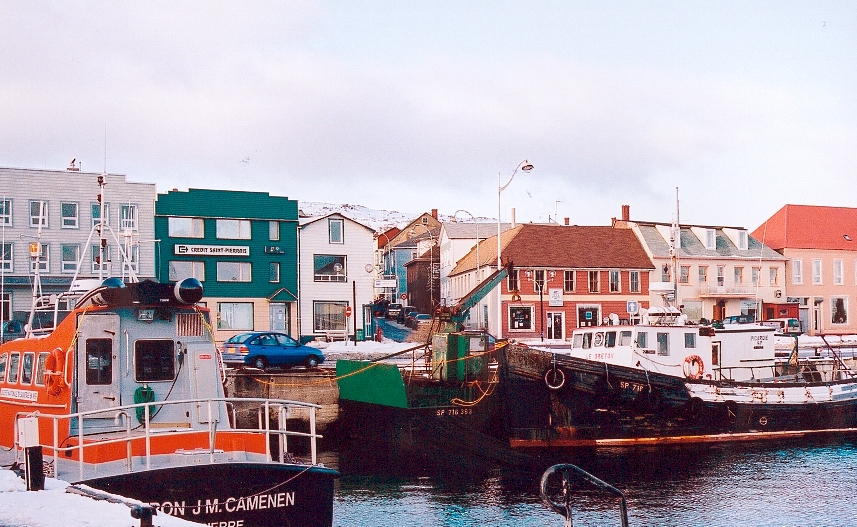
Situated 1,800 kilometers from Quebec lies an archipelago of two French islands: Saint Pierre and Miquelon, home to just 5,513 people. In 2019, the island’s metrics garnered global intrigue, when it was reported that the island’s average annual gross wage income (€31,900) topped that of mainland France (€21,760), excluding France’s overseas region of Mayotte. What if that prosperity wasn’t just a one-off, but the product of an economy that has repeatedly reinvented itself after losing its main industry?
When tracing the island’s history, cod fishing served as the region’s backbone, boosted by a boom in Basque, Breton, and Norman settlements during the 16th and 17th centuries. However, an economy solely reliant on fishing was bound to collapse. In 1992, severe overfishing depleted regional biomass, and Canada implemented a total cod fishing moratorium. The same year, an arbitration ruling granted the archipelago an exclusive economic zone of 12,348 km², settling the maritime dispute with Canada and raising the possibility that oil reserves might lie beneath the waters, though none have been developed.
With its economic model constrained, the archipelago leaned on France for support. The French government currently subsidizes essential transit links for imports and exports and funds local development projects. One example is the multi-year energy plan (programmation pluriannuelle de l’énergie, or PPE) overseen by the French state, which includes a planned 5MW wind farm on Saint Pierre. This plan supports the broader French mandate for its non-interconnected overseas territories to achieve a 100% renewable energy electricity production mix by 2030, and energy autonomy by 2050. Furthermore, direct development funding from the European Union, leveraging a partnership framework dating back to 1985, has consistently backed the archipelago’s long-term initiatives in climate resistance and sustainable development.
Tourism is now the island’s latest version of the same strategy after its previous economy was bottlenecked. The islands market themselves as the last remnant of French North America; just a short ferry ride from Newfoundland they offer vast plains and coastal landscapes as a microcosm of French coastal life. Meanwhile, French gastronomy, from local livestock, distilleries, and cheesemakers to seafood is at the forefront of promotion to Canadians and Americans.
The question that remains: did the fish ever make their return?
Despite France’s government funding to bring back fishing at a much smaller scale through aquaculture programs, the fish have never fully returned. Past attempts at bivalve mollusc production on Miquelon have ceased entirely and the island harvests just 2,000 – 3,000 tonnes out of 30,000 tonnes of potentially exploitable marine biomass.
The tension in their economy lies in over half of the working population sitting in the public sector, where the 2019 average annual gross wage was 1.8 times the mainland French level. Beneath that sits a private sector whose appeal is seemingly too risky to take hold. Outwardly, the islands seem strong; however, thier foundation is deeply rooted in dependance, where France has created a safety blanket that is too strong to unwrap.
Saint Pierre and Miquelon’s dependence has a cost. Imports are closely split between Canada (41.7% of goods) and France (52.4% of goods), leaving the island sensitive to changes in both economies. Canadian prices rose by 19.9% between 2020 and 2025, and that inflation flowed straight into the island’s goods. As the archipelago operates in euros, which is weakening against the Canadian dollar, the cost of Canadian imports is becoming more expensive for islanders.
Although, one industry in particular could benefit from rising import costs— shifting how the island generates electricity. Currently, fossil fuels account for 100% of the island’s electricity production, meaning every home and business depends on a fuel whose price they cannot control. The planned wind farm on Saint Pierre is one of the steps to reduce that exposure, and expanding wind power further, such as to Miquelon, could further reduce fuel imports. However, building that kind of capacity is difficult for a small system. After all, minimizing dependence on imported goods is no easy feat.
Every pivot in the archipelago’s history has followed a loss, so now the test becomes whether the next pivot can come before it. That question reaches far beyond Saint Pierre and Miquelon, as small regions everywhere are learning that the strength in position lies less in what it earns today than in how readily it could be reshaped. The question remains whether Saint Pierre and Miquelon, and islands alike, will exercise individual choice to build an economy less dependent on outside forces.