The faces of revolutions around the world are becoming younger and younger. But how much does the youth truly care about the political state of the world, especially in Canada?
Gen Z has a reputation for unabashed and brazen dedication to spreading awareness about causes that speak to their hearts. Now that many of them have reached voting age, they have an opportunity to influence elections and political organizations. Seeing young people represented in office is rare, but these politicians are still present, even if they are few in numbers.
The average age of a member of the Canadian Parliament is 52 years old, with the youngest being 27. However, when looking at cases closer to home, Elections Quebec data showed that only 116 out of 908 candidates in the 2026 Quebec general election were between the ages of 18 and 29, which was approximately 12.7%. It can be difficult to run for elected office at a young age due to a lack of accommodation and the high cost of entry for campaigning. Nonetheless, the younger generation can still make their voices heard by voting in both federal and local elections.
“When politics is a game only some get to play, it becomes repulsive for young people growing up and trying to think about our system as one that really serves the public.”
When comparing the statistics from federal Canadian elections across different years, Elections Canada data shows a substantial difference between voter turnout in past years to today. From 2011 to 2025, voter turnout in the age groups of 18-24 year-olds increased by 44%. However, the 2025 results still have not surpassed the voter turnout of 57% in 2015, when Justin Trudeau, then leader of the Liberal Party, was first elected. It is clear that despite the fluctuation of voter turnout, the amount of younger voters has substantially increased. Nevertheless, there are still many obstacles that prevent the younger generation from participating in their formal civic duties: “There are a lot of unnecessary barriers in the system to get from start to finish through politics, many of which are only accessible to those with money,” said Jahen Braves, CEO of Young Politicians of Canada, in an interview with CBC. “When politics is a game only some get to play, it becomes repulsive for young people growing up and trying to think about our system as one that really serves the public.”
Most political campaigns tend to focus on retirement, home ownership, and taxation, all of which are important issues, but not necessarily ones that address the concerns of younger voters who are learning about the intricacies of politics and the government. Issues such as climate change, student debt, and the employment crisis are frequently glossed over, making younger voters feel disillusioned with the politicians who are supposed to represent them. Witnessing corruption and unfulfilled promises can lead to youth detaching themselves politically. However, despite their dissatisfaction, younger generations continue to find ways to make collective change.
An array of political movements has inspired Montreal students to stand in solidarity with protestors around the world. For example, the French lycée protests have inspired Montrealers to take to the streets on October 17th 2026, as they voice their concerns over the cost of living and rising tuition fees. While some may argue that Quebec students do not face the same struggles as French students, it is important to recognize that citizens should not have to wait until they go through the worst possible conditions to speak out about certain issues. One issue that has particularly stood out to McGill students is the ongoing war in Gaza since 2023.
…it is important to recognize that citizens should not have to wait until they go through the worst possible conditions to speak out about certain issues.
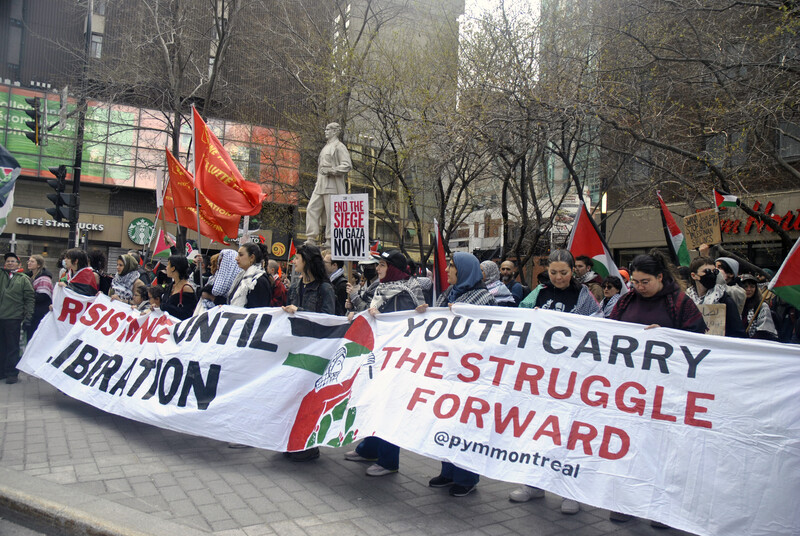
One of the most notable recent protests at McGill University was the pro-Palestinian encampment that occurred from April 27 to July 10 2024. Student protestors demanded that the university cut ties with Israel by divesting funding towards weapons manufacturers and Israeli universities. At first, the SPVM (Service de police de la Ville de Montreal) repeatedly claimed that the protesters were peaceful, a statement that the McGill University administration disagreed with, with the president referring to the protestors’ behaviour as “unequivocally antisemitic.”
The occupation protest garnered substantial traction, including the attention of the Premier of Quebec at the time, François Legault, who called for the dismantlement encampment to be dismantled, as he described it to be “illegal.” It was eventually taken down by a large force of police officers. This did not discourage the pro-Palestinian protestors: many other forms of protest, such as walk-outs, were organized, with the most recent being the demonstrations held on October 7th 2026, the third anniversary of the Hamas-led attacks. The pro-Palestinian students continued to demand that McGill University cut ties with Israel over what they describe as its assault on Gaza, which resulted in a counter-demonstration by Jewish student groups, who held a vigil as other groups came to support them.
As students feel increasingly dissatisfied with official institutions, protests such as these give them the motivation and hope that they might one day enact change, even if it might not be through formal political means. This civic participation might eventually inspire the youth to become politically involved on a larger scale, but first, more efforts must be made to provide proper education on politics and systems of governance, as well as to reduce barriers in order to make youth voting more accessible. Until then, only time will tell what the future holds for youth civic participation in Canadian society.