McGill fashion can’t be summarized with one face, one style, or one colour palette. A diverse, vibrant city has produced a landscape of creativity and individuality, and a large, international student body interacts with it in many ways. Less than a semester in Montreal has exposed me to countless styles I would never have encountered in my suburban Illinois hometown. Interested in how other McGill students navigate this, I interviewed four first-years about what fashion here means to them.
For Arts and Science student Asia Urquhart, it is a change in scenery. Coming to Montreal from Halifax, Nova Scotia, Urquhart described a shift in attitudes towards fashion. “It was weird to wear kind of, like, what was authentic to me at my high school…I always wanted to be a bit more eccentric or more, like, unique to myself and my style and my expression.” She found that McGill presented an opportunity to feel at home in a less conservative, more open-minded environment where people experiment with fashion without fear of judgement. “I would say that was not the norm for Halifax,” she noted. McGill’s fashion climate provided not only a physical change in scenery, but an academic one, too. As someone on an Arts and Science path taking multiple STEM classes, Urquhart’s whimsical, colorful style rejuvenates her creatively; “I’m a creative person, like I used to do a lot more art than I am doing currently, just because I don’t have the materials, so I feel like sometimes fashion is the only way I get to, like, be creative in a day or be expressive.” Evidently, interest in fashion at McGill provides a creative outlet for individuals across faculties. If artistry isn’t necessarily prioritized in the classroom, it persists on students themselves.
For others, McGill fashion is a home away from home, one connected to other creative cities internationally. Rosa Mae Sueuga, an Arts student, found parallels between Montreal and her hometown of Berkeley, California. “I think Berkeley and Montreal have a really interesting fashion scene because of the fact that they kind of, from my perspective, reject a lot of, like, the ‘what brand are you wearing?’” Sueuga’s move from Berkeley, one of the most socially and politically progressive cities in the United States, to McGill sustained rather than shifted her approach to personal style, one rooted in unique secondhand pieces over collecting name brands.
Similarly, Alea Farkas, a Management student hailing from London, England and Toronto, Ontario, sought a continuation of London’s unfettered fashion scene. “I would dress in some crazy shit [in] high school. Like, I’d have, like, full-on heels, and, like, come in some crazy-ass outfits, and I kind of developed that sort of, like, armour.” Aside from the higher-priority components that factor into university decisions, community fashion scenes are indicative of overarching social open-mindedness. “That definitely, for sure contributed to why I picked the city,” remarked Farkas. “Like, if I was a person who grew up in different circumstances, and I was looking to McGill as someone who likes fashion and dressing up, even, I definitely would be in the position to feel more free here… Montreal just allows that.” As noted by Sueuga, “Growing up around people that kind of used what they were wearing to express their political beliefs, or just to express themselves in kind of unconventional ways, was really cool.” At McGill and Montreal at large, people from varied backgrounds reap the benefits of this freedom.
In some cases, a fashionable student body means pressure to dress well, even when you don’t feel like it. According to Marlowe Vassallo, an Education student from Toronto, this is beneficial. “When I’m on campus, and everybody’s dressed and, like, they’re in really nice jeans and, like, people are even wearing dresses sometimes, I’m like, okay, I’m just in my sweatpants, and it does make me feel a little bit underdressed,” he remarked, “but I think overall it’s had a positive impact on motivating me [to dress better].” Urquhart shared this sentiment: “Maybe there’s a bit of pressure that’s, like, even if I need to go grab, like, groceries or whatever, I’ve got to get dressed up. […] Even though it’s like, yeah I feel a bit of, like, pressure to dress nicely…I really enjoy it.” All the interviewees shared my experience of being positively challenged in the realm of personal style in their first semester. Even the ever-experimental Farkas added: “I think it’s been intimidating coming into a city where there are a lot of people who are very fashion conscious… at McGill, I think the fact that everyone is just so interested in it set a new standard for me.”
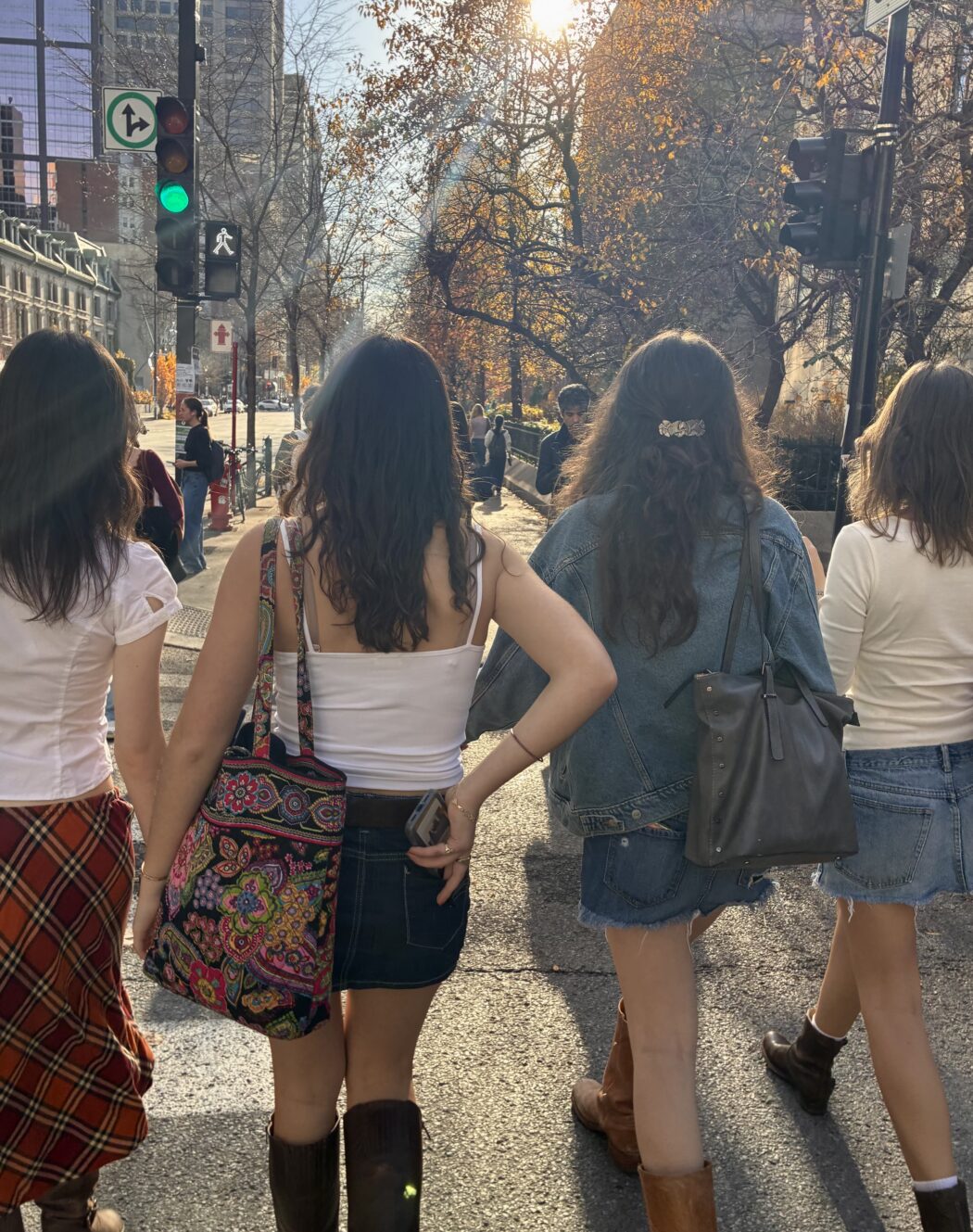
If McGill fashion is defined in any tangible way, it is by a remarkable secondhand clothing market. Vassallo explained: “The vintage stores here, I think, are a lot more curated, and they have a lot more options than [in Toronto]… I feel like you can advance your sense of style with, like, less economical risks.” Vintage as a cultural focus, over designer flagships or fast fashion retailers alone, foments a valuation of quality staples. A timeless “base” paired with unique thrifted finds creates Farkas’ theoretical Montreal uniform: “High brown boots, a miniskirt, a cute tank top, and a jacket. That was, like, very much a staple I would see with girls, […] and a cool belt. You have to have a cool belt, and you have to have a cool bag.”
However, what many newcomers, including myself, have yet to experience is a Montreal winter. Frightening accounts of slippery streets and gargantuan sheets of snow will soon transform fall wardrobes, and a surprising number of non-local students are unprepared. “I only came over with a leather jacket because Halifax doesn’t get this cold, so we’ll see how that goes,” said Urquhart. “By force I come from California,” said Sueuga, “I’ve never dressed for a winter before, so that’s gonna definitely evolve. It’s just, like, survival. It’s gonna be a new chapter.” Nonetheless, I don’t foresee the cold cramping anyone’s style. If we can count on students at McGill being anything, it is both practical and chic at the same time.
“I think that the fact that there isn’t [one McGill style] kind of makes one,” remarked Vassallo. Any attempt to make a broad, varied fashion scene more specific only reveals more about the sheer diversity Montreal possesses. “Not just fashion, but music, art, creativity, all of that,” explained Urquhart. “Those things are just more expressed here and it’s not as, I guess, shameful if you, like, wear things that not everyone’s wearing.” In a lively city surrounded by students from over 150 countries, it’s hard to feel constrained when it comes to experimenting with fashion. Clothes become an emboldening tool for self-expression rather than conformity for students across faculties. “I kind of have never had the dress code mindset, I guess. Like, it’s just whatever, amazing. Whatever goes,” said Sueuga. “You really, truly, have, at least in my opinion, a lot of space to grow, but also to just do whatever,” added Farkas. Hopefully, McGill will continue to be the fashion and cultural epicenter it is, and first years can carry their sense of comfort and community into the rest of their time here.