Picture an alien. What does it look like in your mind’s eye?
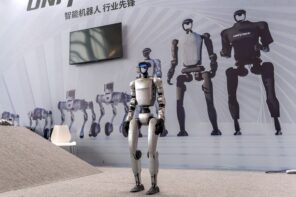
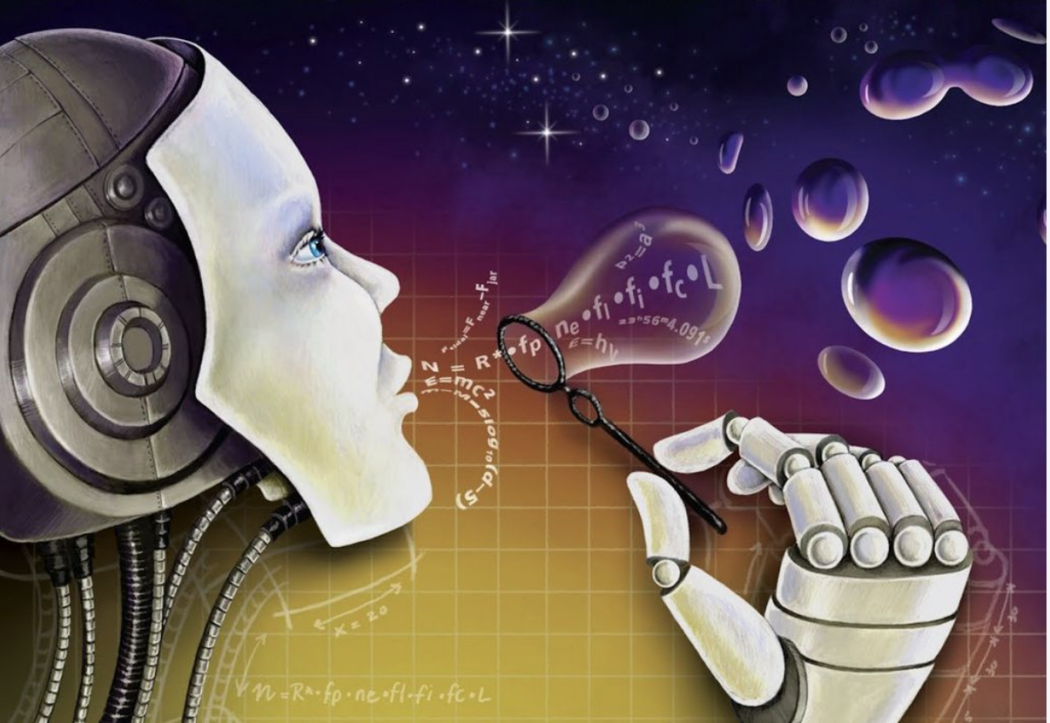
Now, think of a robot. What do you see?
When I asked my friends and family these questions, their responses to both included descriptions of two-armed, two-legged beings that stood upright with a head and torso. But they weren’t thinking of humans. The aliens had green or blue or purple skin, limbs that wiggled and oozed, and fewer or more digits than twenty; the robots had metallic complexions, accordion limbs, and claw hands. Aliens and robots alike sprouted occasional antennae.
The images produced by those I queried—and the ones you may have conjured, too—are of humanoids. Humanoids are non-human entities with human characteristics. The word “humanoid” is derived from the word “human” and the Greek suffix -oid, meaning “like” or “resembling.”
I believe that our conception of aliens and robots as humanoids is reflective of anthropocentrism, the view that humans are central, superior, and separate from nature. Anthropocentrism has rendered us unlikely to isolate the idea of intelligence from the human form.
This point is elucidated by science fiction. Consider alien characters such as E.T. from E.T. the Extraterrestrial and the Xenomorph from Alien. Though depicted as radically different from us, they retain recognizable stature and temperament, and are able to enter and engage with our world. Likewise, robots in science fiction often take the form of humanoids, from androids to bioengineered clones. Take the Terminator from The Terminator or Ava from Ex Machina, for example. When the ideations of renowned science-fictionists are compared with an ordinary child’s drawing of an alien or robot, it becomes clear that the humanoid is pervasive. It trickles through and snakes across our collective imaginations. Extending beyond anatomy, we imagine aliens and robots to be equipped with intellects that enable them to congregate in societies like our own, with language, culture, and constructs; we don’t simply think of these beings as looking like us, but as acting like us, too. Thus, intelligence becomes seen as a human quality, and is only recognized when it manifests in humanoid form.
Yet we know that intelligence doesn’t require beings to be equipped with human faces, bodies, and behaviours. Recently, observations documented by the Natural History Museum show that octopuses can recognize individual human faces outside of their species, sometimes selectively targeting specific staff members with jets of water. And that’s just one example. But it begs the question: why do we continue to conceptualize aliens and robots as humanoids?
Anthropocentrism affects more than our imaginations; it determines our recognition of intelligence in the life we encounter. With anthropocentrism, the modern human is incapable of relating to other life on Earth that we know to exist or to have existed. That bit about the octopus water-jet targeting? It is considered insignificant from an anthropocentric standpoint. We can’t see ourselves in archaea or bacteria, in protists or fungi, in trees and grasses, in giraffes and whales, or even in our early ancestors and relatives, at least as far as intelligence is concerned.
Even as we’re at the forefront of understanding intelligence in other Earthbound life forms—from octopuses and elephants, to tree roots and slime molds—we’re denying their significance, and continuing to affirm ourselves as separate from and above these beings. We’re fascinated by the possibility of discovering intelligent life elsewhere, and yet still struggle to appreciate the forms of intelligence that already exist around us.
Anthropocentrism has rendered the human form exceptional to a point of isolation. By ignoring the similarities and embracing the differences between ourselves and the other life we’re surrounded by, we have manufactured a false narrative that we are alone and in need of company in the universe. Our conceptualization of humanoids is therefore explained by anthropocentrism. It represents a search for something else, something more “like” or “resembling” us, something other from life on Earth.
And many people are, indeed, searching. Some scientists are looking for life on other planets, while others are looking to invent robots with artificial intelligence. Both of these searches for humanoids hold hope for finding human companionship, regardless of compatibility. This consequence—of compatibility—is rarely considered.
Yet, there is another way to achieve such companionship, with potentially less fallout. Current research is aiming to detect terrestrial intelligence among a variety of species. While scientists have not yet discovered extraterrestrial intelligence, and the validity of artificial intelligence as resembling human intelligence remains controversial, intelligence on Earth exists among life forms we’ve already encountered. What would happen if we were to pursue this advancement, instead?
Anthropocentrism encourages us to conceptualize humanoids while preventing us from recognizing the connections we already have with other forms of life. The average human today has lost touch with their ties to Earth and to its other beings. Some may see disconnection from nature and the quest for technological advancement as the solution to human loneliness, but it could be what’s causing it.
If humans are quite as future-minded as they seem, perhaps what we’ll do next is something far less predictable and far more important than discovering humanoid aliens or robots: we’ll stop seeing ourselves as central, superior, and separate from nature.
With that, let’s pause from looking up, to what’s next, to “progress” and “evolution.” Instead, let’s look down at the ground beneath our feet, and at the invisible forces keeping us here. Let’s look around at all the life we’re already accompanied by, and at the connections between us all.
Let’s put our intelligence to use.