
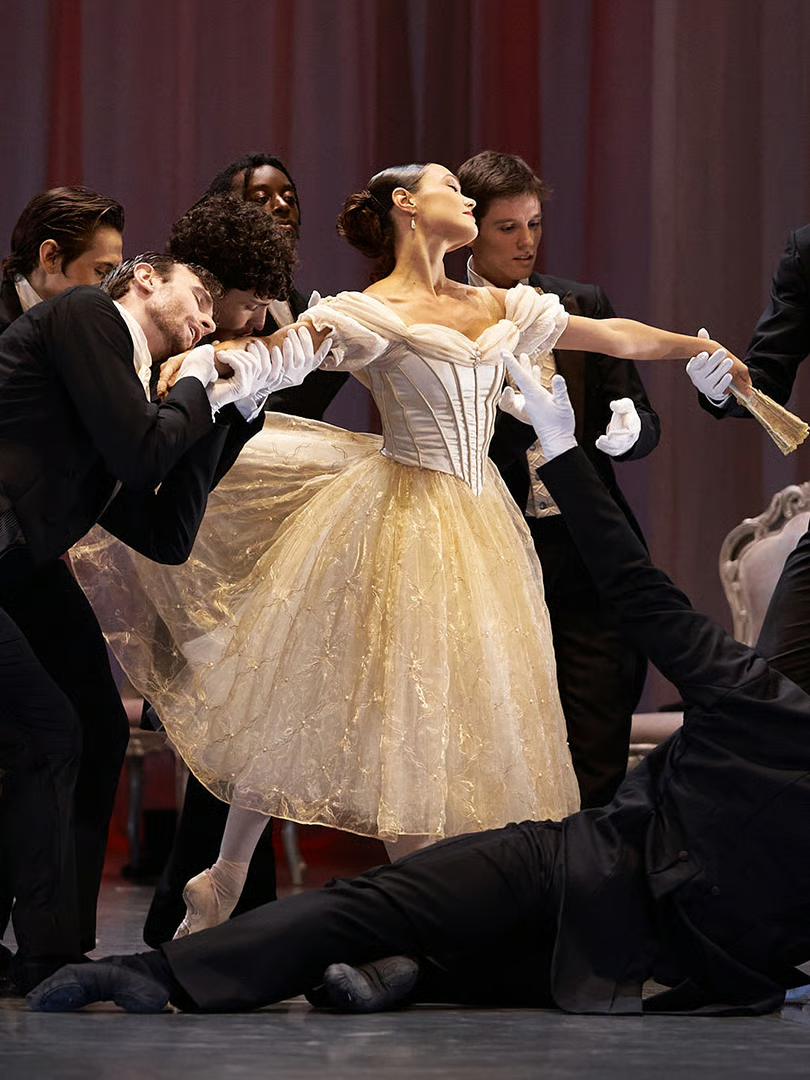
Going to see Les Grands Ballets’ iteration of La Dame aux Camélias, I had already been acquainted with the original story through Alexandre Dumas fils’ writing which had transported me once before to the streets of Paris in the 1840s, or rather, into the secrets of the era’s Parisian elite. Throughout the book, the narrator uncovers the tragic love story between Armand Duval, the son of a count, and Marguerite Gautier, the most beautiful and sought-after courtesan among the French courts. Despite the passionate love they share, Marguerite, at the request of Armand’s father, stays away from her lover to preserve his honour. Soon after, she passes from tuberculosis, leaving Armand heartbroken over their impossible love. The book is rich with the complexity of human emotions and centers the push and pull of the opposition between love and duty. I was particularly interested in seeing how the characters’ inner lives would be communicated through movement rather than words.
When the lights of the theatre dimmed, instead of music, the flutter of a single sheet of paper falling from the ceiling filled the room. Soon after, Jonathan Michaud, the narrator, spoke what I recognized as the opening lines of the book: “Not being old enough to invent, I content myself with narrating […]”. The ballet was punctuated by Michaud’s short interventions—always drawn from the pages of the book—offering the crowd some respite in between the story’s events, similar to how the book is punctuated by the author’s commentary and reflections. This was a fantastic inclusion because it is used as a tool to connect the audience with the story they are witnessing by reminding them that the author and narrator are experiencing the profound emotions of this tale as he is passing it down to us.
The nearly two-hour ballet was structured and divided into two acts, each containing two sections cleverly exploring the themes of the story: Love, Sacrifice, Abyss, and Passing. Similarly, the cast contained three dancers playing Marguerite and three dancers playing Armand. Each couple of dancers was assigned a theme to portray before all the pairs came together to tell the death of Marguerite, further emphasizing the divide felt by the characters through each stage of their relationship. While these artistic decisions may have caused the ballet to feel fragmented and incoherent, the final section—Passing—brings it all together. Marguerite and Armand may have felt like completely different versions of themselves as their actions changed one another throughout Love, Sacrifice, and Abyss—hence the three pairs of dancers—but they remain fundamentally the same: in love with one another above all. Each pair of Marguerite and Armand separates, with the dancers switching partners and effectively breaking the previously established divide. In this story, Love, Sacrifice, and Abyss, as much as they’d like to try, cannot live without one another and Passing reminds them of that. Marguerite and Armand could have existed without one another, but they could not have lived. It is in light of this distinction that the quote used to advertise the ballet—“What a folly love is!” or “Quel enfantillage que l’amour!” in French—roots its meaning.
Unlike the company’s previous productions that were presented in the much larger Salle Wilfrid-Pelletier, La Dame aux Camélias instead was welcomed by the smaller Manuvie Theatre. Though Marguerite was publicly known of by many, she was private regarding her personal life. It was as if the intimate venue invited the attendees to listen in on the secrets of Marguerite’s heart, adding a crucial feeling of proximity with the dancers.
From Love to Passing, Peter Quanz’s choreography accompanies the unfolding of the characters’ emotions while remaining true to the floral theme of the book. Filled with slow and intricate pas de deux, the female dancers’ balance and strength were showcased impeccably and mirrored Marguerite’s own poise and headstrong mindset. However, every attitude turn spreading her flowy skirts like flowers in bloom was a constant reminder of her health’s fickleness. As sickness consumed Marguerite, she, like a flower wilting, would feebly stumble about the stage unable to rise up on pointe, her attitudes and arabesques hanging lower and lower.
The male dancers, on the other hand, showed a commanding but not overstepping presence, accompanying their partners with grace and gentility. In the pas de deux, the men were restrained, mostly showing support for their partners and only occasionally breaking away from them to showcase weightless jumps. Armand’s choreography, unlike Marguerite’s, grew in aggression to materialize his growing frustration with his lover’s secrecy and rejections. As Marguerite repeatedly pushes away his advances, Armand eventually falls in line with the rest of high society that is scrutinizing her. While the book makes us better understand his actions by having Armand talk through them with the narrator, the ballet allows us to truly feel the weight of them on both himself and Marguerite through the representation of his emotions with the imperfect, raw, and asymmetric technique that neoclassical style of this ballet favours.
The dancers spoke directly to me with their bodies and that is what sets the ballet apart from the book. While Alexandre Dumas fils is a thrilling narrator, the elaborate prose occasionally overshadows the raw emotions experienced by the characters, most notably Armand, by filtering the events through the narration’s more distant stance. Les Grands Ballets offered a new avenue to explore La Dame aux Camélias’ story by bringing the audience into closer emotional proximity with the characters. I understood Armand and Marguerite in the book, but I felt for them in the ballet.