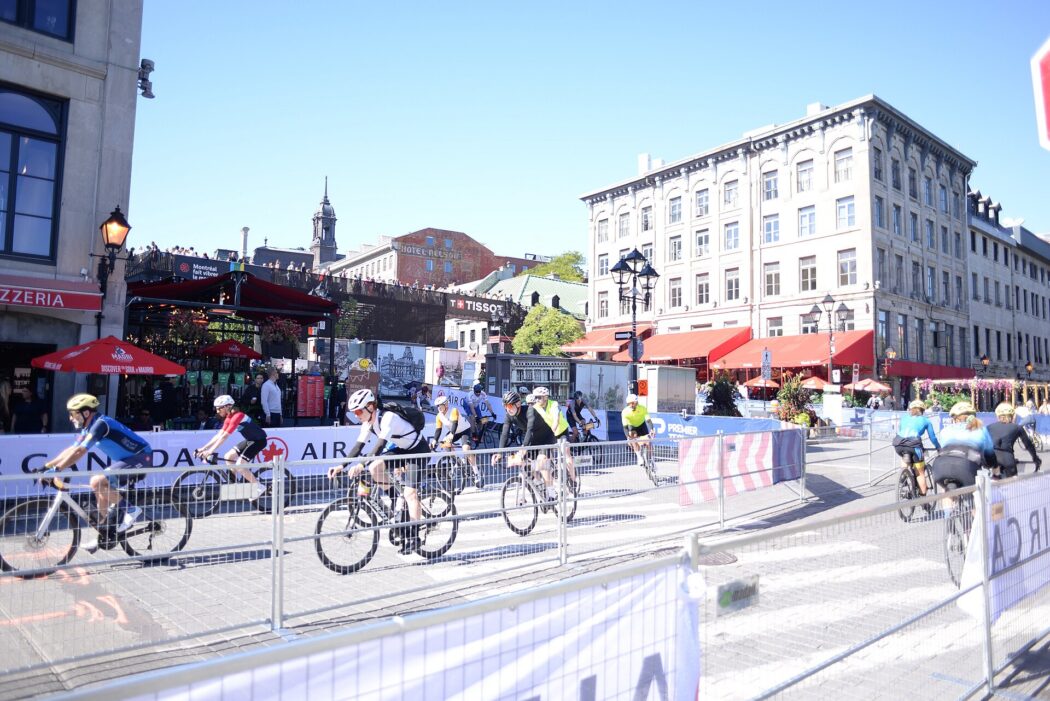
Think about the last two weeks of September. If you live in Milton-Parc, you walked to class around a barricade. If you take the 80 down Parc, you sat in traffic. If you drive, you learned a new route, twice. From September 19 to 27, the 2026 UCI Road World Championships shut streets from downtown to Mount Royal to Brossard, and Parc Avenue stayed closed until October 4.
By most visible measures, it worked. Organizing committee president Sebastian Arsenault said the week surpassed his wildest dreams and that “Montréal a pleinement répondu présent,” or Montreal fully rose to the occasion. Hotel occupancy ran near 90 per cent, climbing to 95 on race weekends. The races were broadcast to 140 countries. And on Sunday, Brandon McNulty won the men’s road race, becoming the first American in 33 years to take the rainbow jersey, on a climb Montrealers walk up on weekends.
What nobody can tell you yet is what it was worth.
Before the event, Tourisme Montréal projected the Worlds would generate $155 million for the city and draw close to 500,000 spectators. The federal and provincial governments and the City put up about $24 million in public money against that promise.
Two days after the last race, Arsenault told Radio-Canada it was “encore trop tôt pour quantifier l’achalandage,” or too early to quantify attendance, and estimated the event should “assuredly surpass the bar of 250,000 spectators.” Tourisme Montréal said it had not yet measured the economic impact, and gave no timeline for doing so.
That gap is worth a closer look. The floor of the post-event estimate is half the pre-event projection, and 250,000 is roughly what the Grands Prix Cyclistes de Québec et Montréal already draw in an ordinary September. The real figure may well land far above that floor, and Arsenault clearly believes it will. But belief isn’t a count.
None of this is a knock on him. He volunteered that the tallying isn’t finished rather than reaching for a firm number. The issue is structural: projections get produced early, publicly and precisely, because they are what justify the spending. Verification arrives late, quietly, or not at all.
Glasgow shows there’s another way. When Scotland hosted the 2023 UCI Cycling World Championships, the UCI commissioned EY to evaluate the event afterward and published the findings: more than £205 million in economic activity (about C$387 million), the equivalent of 5,285 jobs over a year, nearly a million spectators, almost 90,000 from beyond the UK. Same governing body, same kind of event, three years earlier.
A real audit would also have to price something the tourism projection ignores: the pavement. The city resurfaced stretches of the route before the race, including the 1.8-kilometre climb up Camillien-Houde, which cyclists had spent years avoiding because of potholes. That asphalt outlasts the event. But even this ledger is murky. Montréal 2026 technical director Pascal Choquette acknowledged that much of the course was patched rather than properly repaved, and time trial silver medallist Filippo Ganna said the asphalt was “not worthy of World Championships.”
Montreal might well come out ahead in a proper accounting. The Worlds left behind no stadium debt to service, which counts for something in a city that spent thirty years paying off the last time it invited the world, and a week of the sport’s biggest race on the mountain carries value that never fully lands in a spreadsheet.
Which is the argument for measuring it properly, not against it. If the Worlds delivered anything near $155 million, an audit is the strongest case for bringing the next one here. If they delivered a fraction, the city should learn that before it bids again. Either way, the students who spent two weeks rerouted around their own campus have earned the figure. Montreal hosted a great race. Now show us the math.