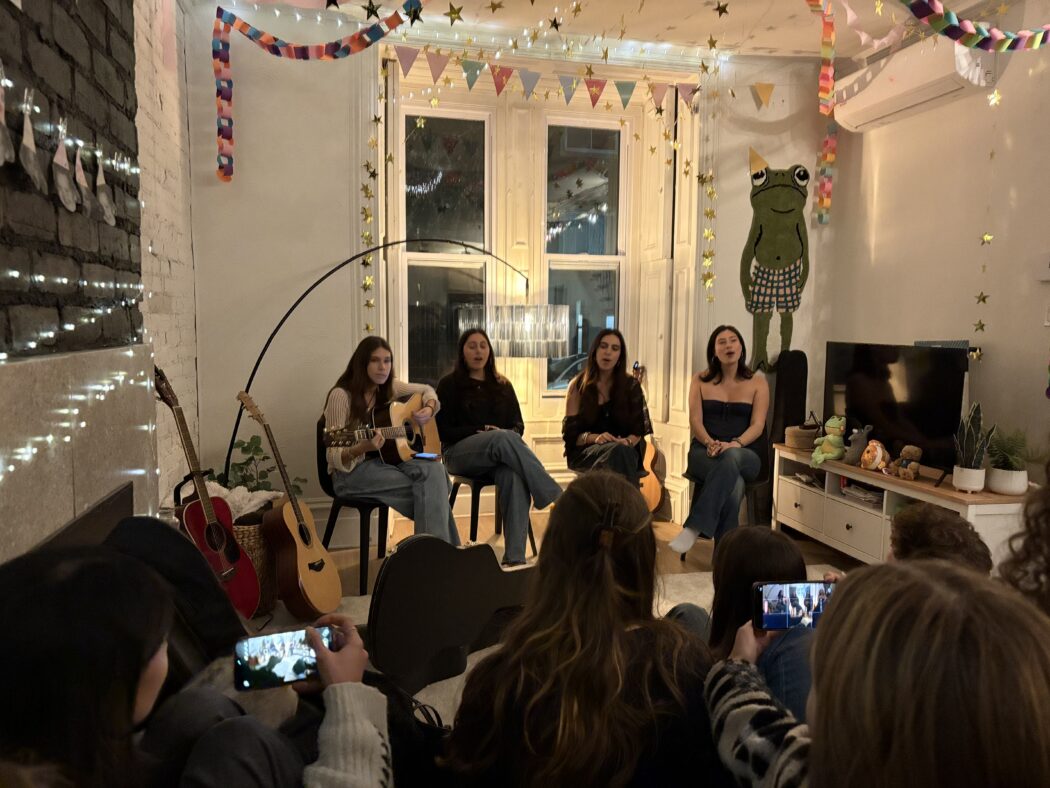
This Monday, as I returned from a five-hour library session, the only thing on my mind was upcoming assignments. I was so preoccupied that when I walked into my home and saw that the furniture had all been intimately rearranged to face four empty chairs, awaiting upcoming performers, it momentarily baffled me. In the kitchen, my roommate and his co-president of Sexual Health Awareness and Research Campaign Montreal (SHARC) were preparing food and snacks for forty guests soon to arrive. I then remembered that in an hour, we’d be hosting a charity “house concert”. My first of its kind, I didn’t know what to expect, but I can now confidently say that I hope we host many more.
As undergraduate students, we are all too familiar with monotonous daily routines. Allow me to propose the average structure: home, lecture, library, home. Common variations might further include the gym, a club meeting, work, a quiet cafe, or perhaps if you’re feeling especially adventurous, office hours. By the middle of the semester, this routine can surpass tedious and verge on grating, as you lug yourself across campus to the same rooms and buildings you see every day. Of course, there are moments of temporary solace, like laughing with roommates, seeing friends in class or at work, and admiring the change of seasons. However, I find that if I don’t take the time to occasionally break the cycle, I can easily get lost in it. Time moves quicker and days blend together.
One of the best ways to remind oneself of life outside this routine is to seek out “third places”. Sociologist Ray Oldenburg coined the term “third place” in 1989 to mean a casual, welcoming space where people can congregate, relax, and build community. He defines third places as distinctly separate from the “first place” of home and the “second place” of work/school. There are McGill students who frequently engage in this kind of space by going to Gerts for Monday night trivia or their student bar on Thursdays, joining intramural teams, visiting their favourite cafes with friends, or spending time at Parc Jeanne-Mance on warmer days. However, many teenagers and young adults have observed a notable decline in third places dedicated to community. Furthermore, there are a number of barriers that prevent students from accessing these spaces and taking a break from their repetitive daily cycles. Cafes require you to purchase an $8 latte to stay, rigorous midterm schedules burn you out, and scrolling becomes an empty but effective distraction from your stress, which all accumulate to make returning home to your couch feel like the only option for reprieve. But this is exactly how you get “lost” in the cycle.
After the magic of Monday night, I can now offer an alternative salve for burnout, loneliness, or whatever other feelings of despair coalesce during the depths of midterm/finals season: the house concert. Although it is not quite a third place as Oldenburg defines it, since its setting is the home after all, the house concert still functions as such. It brings a community of people together to appreciate each other’s presence and the talent of their friends in the midst of a warm, no-pressure environment. Monday’s house concert was hosted by SHARC Montreal (@sharcmontreal on Instagram) as a charity event to raise money for the McGill University Health Centre Foundation. The concert consisted of three acts by local McGill and Montreal artists: AVIV, Sounds of Parry, and David Walsh. Although it was a charity event, the concert’s impact went beyond its cause. My roommate, who is one of the SHARC co-presidents, and an audience member who recently hosted a house concert himself corroborated this sentiment in a post-event interview.
When asked what makes such an event, particularly the setting, so special, my roommate and the concert co-host remarked, “Everybody felt so close and connected… it felt so intimate… like the kind of vibe you can only replicate at a campfire.” Connecting this event to a conversation about third places, the audience member commented, “I think that we see a resurgent desire for third spaces, and although this is technically one of the two spaces, tonight and when I had my concert at my house it became a third space.” The music aspect played a key role in transforming the atmosphere of the house into a communal space. The event was about sharing an experience and appreciating the gifts of friends. When speaking about the audience members, most of whom were friends with the musicians, the host noted that “a lot of them don’t know about the performers’ gifts… it’s so amazing seeing everyone’s face when they learn of their friend’s talents, and it makes us all feel so much closer.” The other interviewee also observed, “The music was so central, but it wasn’t about how well they performed, played the guitar, the note they hit; it was more just about sharing something unrefined. That’s what made it special.”
It must be said that preparation for such an event isn’t always easy, and there are still obstacles to gatherings like these. Watching SHARC’s presidents meticulously set up and interviewing a previous host of a house concert made this apparent to me. The previous host admitted that “it takes a lot of effort and commitment by willing and able people.” Nonetheless, he continued by saying, “It really makes a difference.” This prompted me to ask: what makes the effort so worth it? In his response, he explained, “It’s a break from the daily rhythm of life. It shows how important low-stakes, change-of-rhythm events are to your life. Doing something you don’t have to get ready for, that you can just show up to as you are without the pressure to perform. Except the performers, of course.” Even then, the performances were not about perfection, instead, it was “a way to relax and enjoy what humans can do.”
To end the interview, I asked SHARC’s co-president if this was something he thinks people would like to have more of in the future. He recalled, “As everyone was leaving tonight, they were saying, ‘you should do this every month!’” When planning an event like this, it seems realistic to expect that people are too busy with work and can’t make time. But the co-president said, “When you choose to go, it makes your night, and it’s so worth it.” As a stressed and relatively busy student myself, I can confirm that taking a couple of hours off schoolwork to watch friends perform and enjoy the company of others was certainly worth it. If you don’t believe me, I urge you to try one, or maybe even host it yourself!