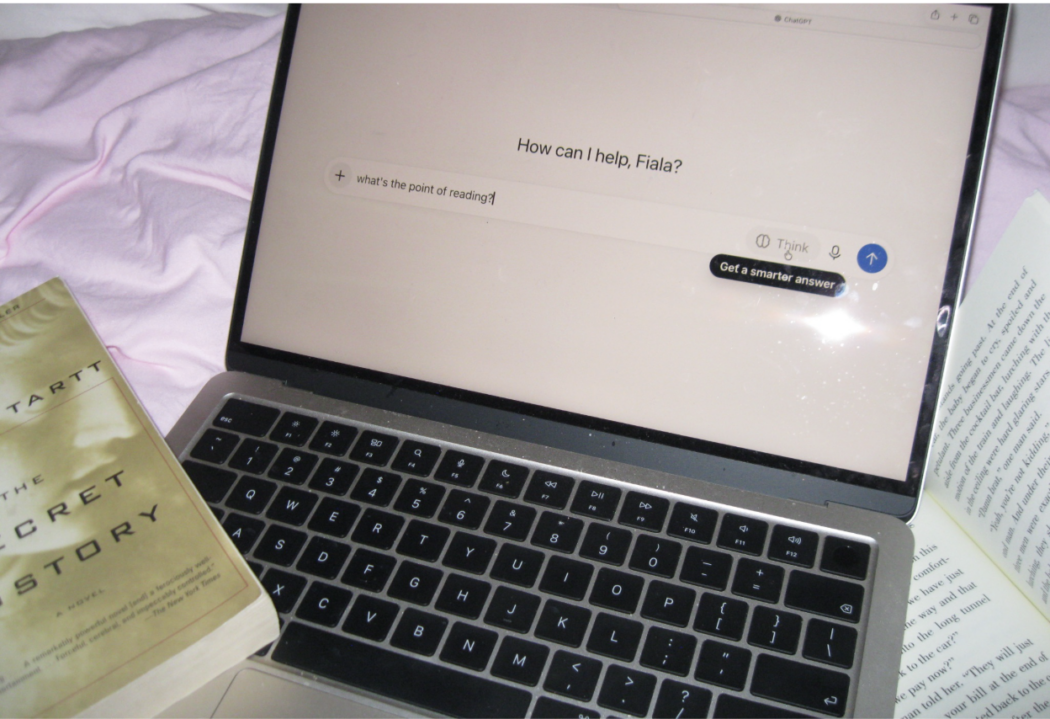
Alix Earle has never read a book. Gen-Z students are taking years of English literature classes without cracking the spine of a single paperback, without turning a single page. The altogether avoidance of reading for class started with sparknotes, and the rise of AI has only catapulted humans into a downward spiral of outsourcing our own thinking. In a world where the difficult parts of learning, studying, and existing can be so easily avoided, why should we feel compelled to continue thinking and processing information for ourselves? Why should we read?
Firstly, reading is incredibly beneficial for us: it’s an exercise in critical thinking, it helps us parse through nuance, better understand the world around us, and it’s amazing for our mental health.
If we rely on AI for every menial task, if we cannot work or function without the use of AI, we are allowing AI to replace our skills with its own. The less we rely on our brain to solve problems, to think of solutions, and the more we lean on ChatGPT to do that work for us, the more we render our own skills obsolete. How can we apply our own critical and creative thinking skills in real life if we stop practicing these skills when it’s inconvenient?
Reading is an exercise for the mind. It’s not easy or convenient, it’s essential; it trains you to think clearly. The act of persevering through writing that isn’t always interesting to get to the core point, and to interpret information and analyze diverse perspectives builds your critical thinking and can be applied to approaching real life experiences. Current events, social interactions, and academic problems all require the analytical skills that come from reading. It’s vital to be able to go through life seeing things beyond surface level facts to the nuance behind them. Every time you pick up a book— which admittedly I don’t do as often as I’d like— you open the door to improving your cognition, training yourself to think more effectively and efficiently. Reading creates neural pathways and strengthens the white matter needed to enhance communication between the brain hemispheres. This makes thinking more effectively and efficiently (ironic, considering the whole point of leaning on AI is ease and efficiency). It’s like strength training: it’s not easy, but it allows you to improve the muscle.
Think about what you want to do most on a grey rainy day; don’t you just want to cozy up by the window with a cup of tea, a warm blanket and… a Claude summary of a really good book? Of course you don’t. Sure, it’s easier to get the gist of the story that way, but you are missing everything positive about reading: the reason that the rainy day reading cliche makes so much sense is because the act of reading and interpreting the content is the focus of the activity, not merely having a base understanding of the book. The relaxation comes from immersing yourself in an experience and allowing yourself to use your own creative thinking: visualizing, letting yourself think about something far from daily life. We would never sit down and curl up with AI and tell it to read for us, because we know there is no value in outsourcing reading in the context of recreation. Why do we justify it for academic purposes then?
There is something dystopian about the way we interact with AI, by allowing it to dictate our own thought process and tell us how to approach problems, instead of using it as a tool to embody our own thoughts. Somewhere along the way, we stopped giving it our input and instead allowed it to input ideas into us. Instead of writing a carefully crafted prompt based on our own knowledge, asking AI to aid us in our tasks, we copy paste the instructions directly into AI and say: do this for me. We have completely cut out our own input, and as such we have cut ourselves off from learning anything.
I believe there’s a way we can stop outsourcing our thought processes, stop letting AI take the wheel. The road starts with hitting the books: incorporating more recreational reading into our lives, and by lowering the amount of AI assistance used for academic reading and assignments, for the purpose of improving cognition, honing vital life skills, and the simple act of relaxing.