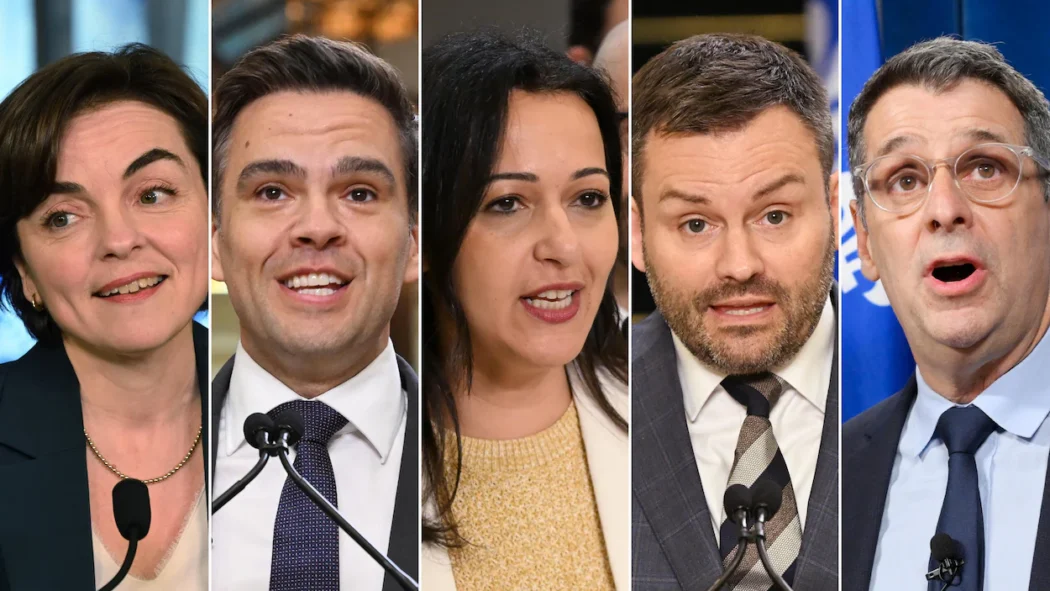
On October 5th, Quebec will elect a new provincial government. It will be the first time in eight years that the province will elect a government not led by François Legault, a founding member of the Coalition Avenir Québec who resigned in January. There has already been controversy surrounding the upcoming election, since for the first time in Élections Québec history, French-only voter cards were provided to constituents for a general election. Élections Québec estimated that complying with a court order to mail additional English reminder cards could cost the province roughly $6 million, which caused uproar within the English-speaking community of Québec. Court cases aside, here is a look at the leaders and proposed policies of the five major parties that voters will be looking to elect as their new head of province.
Coalition Avenir Québec (CAQ): Christine Fréchette
Former president and CEO of the Eastern Montreal Chamber of Commerce, Fréchette ran for leader of the centre-right CAQ after Legault’s resignation and is Quebec’s current premier. The CAQ plans to invest $1,000 in the Registered Education Savings Plan (RESP) of every child born in Quebec after Fall 2027 and to have 5,000 additional reduced-fee daycare spaces by 2030. The party promised to invest $100 million to counter homelessness, along with a $7,500 tax credit for families needing to accommodate elderly relatives. In an effort to “combat crime,” Fréchette is looking to add 300 new officers to the current police force. A major pillar of CAQ’s platform is the proposal to renew the notwithstanding clause for Bill 96, which limits the use of English in Quebec’s public service and mandates French-translation rules for businesses’ storefronts, amongst other measures. The party seeks to protect it from constitutional challenges to affirm French as Quebec’s only official language.
Parti Libéral du Québec (PLQ): Charles Milliard
Milliard, who has never held elected office, replaced Pablo Rodriguez as PLQ leader in 2026 after no other qualified candidates emerged. A previous executive at pharmacy chain Uniprix, he is looking to rebuild Quebec’s Liberal Party after allegations of vote-buying and ethics violations against former party members. The PLQ would reduce the share of Quebec’s international exports going to the U.S. by at least 15%, while diversifying toward Canada, Europe and the Francophonie. Milliard is also looking to eventually build 100,000 housing units annually to address housing challenges. The party aims to relax Bill 96’s restrictions to provide a longer grace period for newcomers to receive communications in both French and English upon first arriving in Quebec.
Québec Solidaire (QS): Ruba Ghazal
As the leader and founding member of the most explicitly left-wing of Quebec’s major provincial parties, Ruba Ghazal immigrated from Lebanon at age 10 and previously worked in environmental management at manufacturing companies. Ghazal became QS’s primary spokesperson after Gabriel Nadeau-Dubois resigned. If elected, QS would implement several cost-of-living measures, including raising the minimum wage from $16.60 to $20 and creating province-owned grocery stores to compete with the five major chains that dominate Quebec’s market. To address the housing crisis, they would create a provincial rent registry and limit rent increases to the rate of inflation. Sovereignty has always been a prominent part of the party’s goals. As such, QS would draft a Quebec constitution as part of a larger push for the province’s independence.
Parti Québécois (PQ): Paul St-Pierre Plamondon
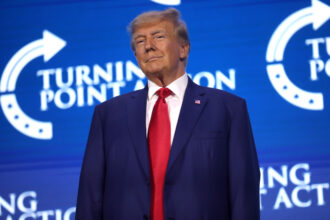
A lawyer and McGill alum, Plamondon became the PQ’s leader in 2020. Currently, the PQ is making some modifications to its proposed referendum timeline. Plamondon stated that the party will not look to propose a sovereignty referendum while Trump remains president of the United States. On the other hand, Plamondon would like to strengthen French education standards in schools and CEGEPS. In addition, the PQ would put forward a bill to ban surveillance pricing in grocery stores and abolish the Quebec Sales Tax (QST), a provincial added tax of 9.975%, on used goods. It has also stated that immigration to the province has put pressure on the housing supply, which is why they would look to cap permanent immigration levels to 35,000 a year.
Parti Conservateur du Québec (PCQ): Éric Duhaime
Duhaime was a political commentator and author before taking the lead of the PCQ in 2021. Along with its leader never having held elected office, the PCQ has also failed to win any seats in the 2022 election despite receiving 12.9% of the popular vote. In accordance with fiscally conservative policy, the party aims to cut government spending by $47 billion over five years and create tax cuts for families and businesses. Personal income taxes and consumption taxes will also be included in the cuts. It would combat the housing crisis through rent subsidies. Duhaime would add between 400 to 500 more annual admissions to medical school in response to Quebec’s urgent shortage of medical professionals. Lastly, one part of the PCQ’s platform would be to remove the provincial gas tax for 5 months.
With election day quickly approaching, Quebec’s constituents, including the McGill students who are eligible, will be voting on a multitude of issues, from housing and affordability to Québec’s language and sovereignty, with parties each offering a unique vision for how to address them. Polls currently have the PQ in a tentative lead of 28.9%, but the number could easily be different on October 5th. For many McGill students, this may be your first opportunity to vote in a provincial election. Regardless of which party best reflects your priorities, make sure your voice is heard at the ballot box.