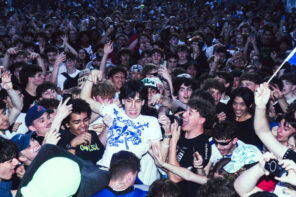
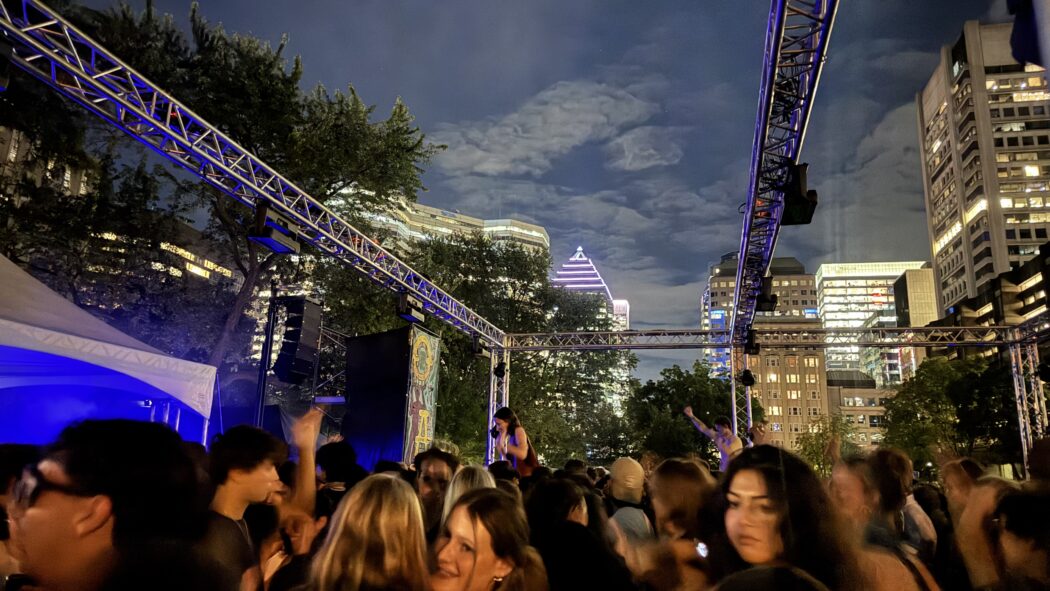
As the academic year kicks off, one question can be heard all over campus: “Are you going to OAP?” What once started as a simple gathering of engineers-to-be is now one of McGill’s most popular events, bringing together students from all faculties. Twice a year, the Open Air Pub (OAP) welcomes thousands of students, transforming a patch of grass into two weeks of music, food, and fun that all students look forward to as classes start back up.
Founded in 1982, Open Air Pub started small: a handful of engineering students handing out drinks from a single table, according to accounts passed down by organizers. Back then, there was no stage, no sponsors, and definitely no guestlist. And guess what: OAP wasn’t always held at the beloved Lower Field. Ever walked by the green space next to the Redpath Museum with the empty fountain? That’s called Three Bares Park, and it’s where OAP was first hosted. Since then, OAP has outgrown its original venue. Just picturing trying to fit a stage, drink and food stations, porta-potties, and hundreds of attendees all into that little space seems impossible today.
To this day, OAP is still run by the Engineering Undergraduate Society (EUS) as a fundraiser, with profits going toward various student associations and nonprofit organizations. Running an event of this scale takes a lot of coordination, and OAP has a whole team of volunteers behind the scenes making it all possible.
Jacquie Hayes-Babczak, an engineering student, first got involved by volunteering at the food station in her second year at McGill. She is now one of OAP’s music managers, helping book the stage, performers, and DJs. According to Jacquie, planning for OAP’s fall edition, called OAP Full, actually starts during the month of May, while planning for the spring edition, OAP Lite, starts at the end of January. As a music manager, Jacquie puts out a call for artists and DJs, who send in recordings for consideration. From there, she and her co-manager evaluate every submission, carefully considering how different acts might contribute to the event’s overall atmosphere. Their goal is to create a lineup that brings together a mix of student bands and other guest performers that will make OAP the place to be, such as Piknik Electronik’s iconic DJ TALLANDSKIINY.
Beyond the music, there is also a significant amount of logistical planning. Jacquie explains that OAP organizers work closely with the McGill administration on everything, from water access to food-related equipment, such as the grills, to permits and safety requirements. The team follows strict safety regulations and coordinates with McGill’s security team to help ensure students’ safety throughout the festival. They also work with the fire prevention office to ensure enough fire extinguishers are on site in case of an emergency, as well as with the sustainability office to keep the event as environmentally responsible as possible. And if you’ve ever wondered why the party has to end so early every night, it’s because speakers cannot be used before 6 p.m., and all music must end promptly at 9 p.m., as per McGill’s request.
For Jacquie, however, one of the biggest challenges has less to do with the logistics themselves and more to do with finding the time to manage them alongside everything else, stating:
“The most challenging part about pulling off an event like this is remembering that we’re still students– all of us managers are volunteering our time to do this, so juggling school and other extracurriculars with OAP organization can be tough, but we do it because we love it.”
From a chill outdoor hangout in the early 80s to what is now a complex festival with thousands of attendees, OAP is much more than just a fundraiser. It’s a back-to-school ritual in the fall, an end-of-year celebration in the spring, and most importantly; it’s the Best Place on Earth.