
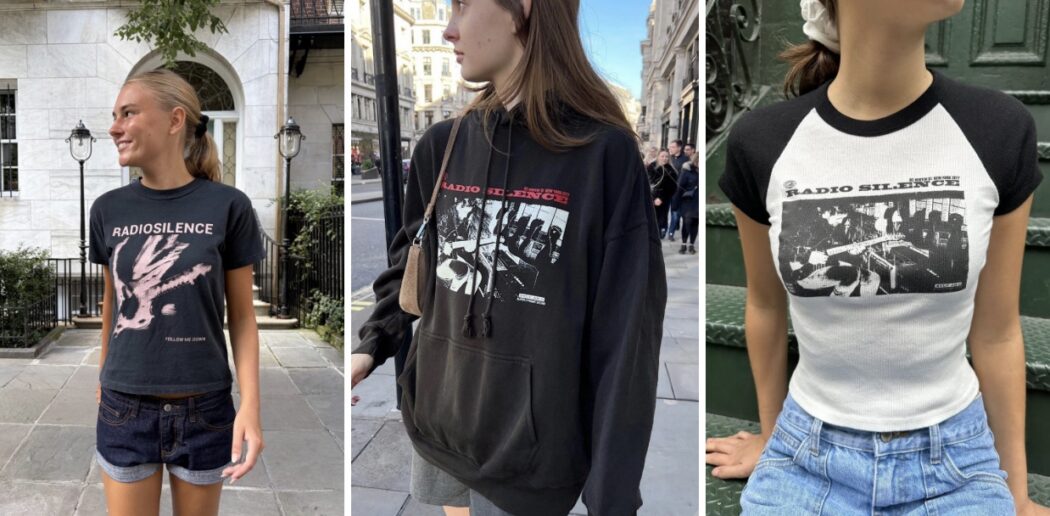
Upon moving to Montreal at the start of my first year at McGill, I was thrilled to find out that there was a Brandy Melville on Sainte-Catherine St. West, a scant twenty-minute walk from my residence. These softly-colored, meticulously-decorated stores are scattered pretty sparsely across the United States and Canada, but the clothes have made up a majority of my closet since middle school. I appreciate finding well-fitting basics, cotton, and colorful, nostalgic patterns for a reasonable price compared to other mainstream brands. In my recent visits, something present both at in-person Brandy locations and on their online storefront for a long time has piqued my interest: their Radio Silence line.
Since 2022, Brandy Melville has been producing T-shirts, tank tops, hoodies, and other merchandise featuring the fictional indie-rock band Radio Silence. Taking inspiration from 1990s band fonts and screen printing, the products hazily recall similar 90s band tees from bands like The Stone Roses, The Sundays, and Radiohead. They perfectly capture a faux-vintage essence in a faded, bichromatic package.
The imagery was just indistinct enough to make me wonder: why have I never heard of this band? Why are they featured so heavily on the Brandy website? I soon found out that Radio Silence was invented in-house for copyright avoidance; if it were to collaborate with a real indie rock band, Brandy Melville would have to pay licensing fees. This practice isn’t unusual among teenage clothing brands like Hollister, Abercrombie, and Garage. They often employ vague or invented locations, sports teams, and clubs for graphic products, but Radio Silence stood out to me due to the effectiveness with which it bottled its intended energy. From a design perspective, the line is executed perfectly, but it made me wonder if selling the mere impression of indie band merchandise is a fundamental disservice to the real bands that contributed to the styles they co-opt, and if buyers are somehow “posers” or “performative.”
Teenage girls, the prime demographic of Brandy Melville, have long been a disproportionately large target of criticism in “poser” discourse. Many girls are familiar with being asked, “You listen to that artist? Name five songs,” while wearing band merchandise, especially of genres dominated by male audiences. However, wearers of Radio Silence products aren’t necessarily fans of indie rock; in fact, their musical tastes might not align with indie rock at all, because the merchandise carries no historical power or latent meaning. That isn’t to say that personal meaning is necessary in the clothing we wear – wearing a shirt that says “NYC,” for example, doesn’t mean that New York City necessarily has any personal meaning to you. Nonetheless, Radio Silence is a consciously enacted hollowing of meaning from a genre built on the rejection of overproduction, authenticity in lieu of commercial formulas. What does it mean to wear a band tee of a band that isn’t really a band, but the concept of a band?
Lighthearted questions of branding become more serious ones of the disempowerment of independent artists at the expense of mainstream aesthetic appeal. Curiously enough, plenty of real-life underground bands possess styles conducive to a cute, Brandy-worthy T-shirt such as The Runarounds, West 22nd, and Friko. Brandy prioritizes brand recognition over the appreciation of artistic talent, especially at the dawn of an artificial intelligence boom where human art is increasingly being expedited and undervalued.
I can understand why Brandy would prioritize brand-specific symbolism, but at the same time, corporations that benefit from diluted versions of alternative styles have an ethical responsibility to pay homage, social and monetary, to their pioneers. If not, complex styles of music, film, and fashion become misty implications of what they once were as they are commodified past the point of their former identities.
Radio Silence and the wider commodification of the indie band aesthetic subtly wear down how the collective thinks about music culture. These products are something that we have accepted in the modern fast fashion climate. My friends and I still find ourselves picking up cotton baby tees from Brandy from time to time – but that participation doesn’t negate the importance of talking about these issues and constantly asking questions about why they take place. I own many Brandy products, and you may, too, but I encourage you to keep supporting the indie brands that the Brandy style is built upon, whether by buying their merchandise, going to underground concerts, or streaming their music.