
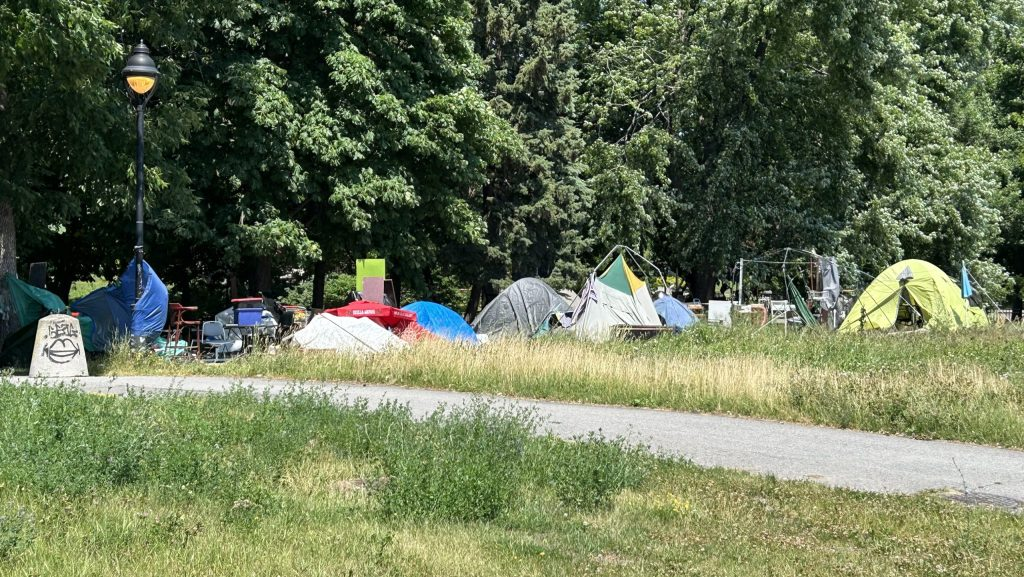
Montréal did not discover homelessness on September 11, 2026. But when an infant was found near a homeless encampment on Notre-Dame Street in Mercier-Hochelaga-Maisonneuve, a crisis that had long been part of the city’s urban landscape suddenly became a central issue in Québec’s provincial election.
The infant has since been referred to the Direction de la Protection de la Jeunesse (DPJ), Québec’s youth protection agency. The circumstances surrounding the incident still remain unclear. The discovery drew reactions from political leaders across the province, with Montréal Mayor Soraya Martinez Ferrada threatening legal action against the Québec government for their lack of progress in combatting the province’s growing homelessness issue. Meanwhile, opposition leaders also called for stronger social safety nets and greater investment in housing.
According to provincial government estimates reported by The Canadian Press, in 2025, an estimated 12,000 people were unhoused in Québec, with a staggering 42% living in Montréal. For years, the city has struggled with the growing presence of homeless encampments and has developed procedures to manage associated risks. According to the city of Montréal’s official website, encampments are regularly assessed for health concerns, crime, and fire hazards. Additionally, the Équipe Mobile de Médiation et D’intervention Sociale (EMMIS) provides around-the-clock assistance in non-emergency situations, connecting vulnerable individuals with social services.
Homelessness risks becoming something the city learns to accommodate rather than a crisis it actively works to resolve.
Although these measures play an important role in protecting vulnerable individuals, they also raise questions about the city’s long-term approach to homelessness. When temporary encampments become established parts of the urban environment, as seen in Montréal, homelessness risks becoming something the city learns to accommodate rather than a crisis it actively works to resolve.
The discovery of the infant, however, appeared to bring a new sense of urgency to the issue. Coalition Avenir Québec leader Christine Fréchette announced a campaign proposal of a $250 million emergency fund to fight against homelessness, alongside commitments to establish transitional housing and additional social services. Additionally, according to The Canadian Press, Québec Solidaire has pledged billions in housing investment, while Projet Montréal called for 30 unused modular housing units to be made available.
Yet, while politicians debated the future of Montréal’s encampments, the people living in them faced a different set of concerns. In an interview with Erika Morris of The Canadian Press, Dan Dumont, who has experienced homelessness for more than six years, offered a contrasting point of view to the political attention surrounding the crisis. Dumont explained that he had not been following the election campaign and was unaware of the story of the infant’s discovery. Instead, he was preoccupied with the threat of theft, his deteriorating health, and the approaching winter. Like Dumont, other residents interviewed by The Canadian Press have expressed similar concerns, feeling that political promises offer little immediate certainty about where they will sleep or how they can access stable housing.
The dangers associated with living in an encampment […] are conditions that thousands of unhoused adults face every day.
This contrast raises an important question: What makes a social issue such as homelessness politically urgent? The infant’s discovery rightfully prompted widespread concern over the child’s safety. However, the dangers associated with living in an encampment are not unique to children. They are conditions that thousands of unhoused adults face every day.
The incident has brought Montréal’s homelessness crisis to the forefront of political discussion once again, creating an opportunity for meaningful change. But as another winter approaches, the question remains whether the attention generated by the child’s discovery will translate into real change for the thousands of adults who have long been living through the same crisis.