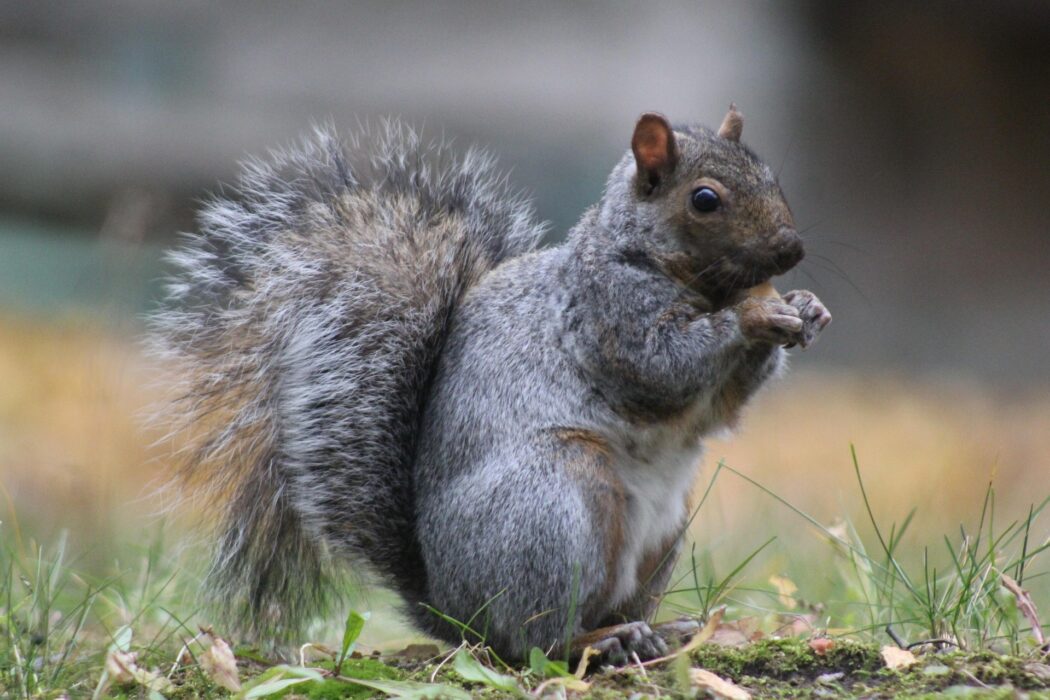
According to a study conducted by McGill University, humans are not the only species impacted by their surrounding environments. Squirrels, too, are shaped by the evolution of their habitats, including urban environments. Researchers observed squirrels across different Montreal neighbourhoods and found differences among those living in different districts. Previously, similar studies had only compared the evolution of squirrels in towns and in rural areas.
Francis Quang-Hai Dinh, a researcher in integrative biology at the University of Illinois Urbana-Champaign and a former McGill student, searched for squirrels by biking to about 200 parks around Montreal, going from Mirabel to Saint-Bruno. He observed more than 800 black and grey squirrels.
In an interview with CBC News, Dinh said: “We don’t even think of squirrels as being animals. They’re practically just pests, but they are indeed wildlife.”
Why are there more black squirrels in the north?
Dinh found that black squirrels make up 12% of Montreal’s squirrel population, and that the percentage rises farther north. Indeed, Dinh stated that 20% of the squirrels in Laval are black, whereas the majority of squirrels in Montreal are grey. He mentioned that in areas located north of Laval, the amount of squirrels that are black goes up to 40% of the total squirrel population.
“We don’t even think of squirrels as being animals. They’re practically just pests, but they are indeed wildlife.”
According to Dinh, three factors may explain why black squirrels are more common farther north, with climate playing the largest role.
In an interview with CBC News, Dinh stated that squirrels in Montreal have an advantage in colder environments “[b]ecause their black coloration can absorb better heat than the greys.”
Additionally, there may be more black squirrels in the north due to the dense trees and the forests having a canopy, causing black squirrels to have more camouflage.
Allison Roth is an assistant professor at the University of Missouri and is the senior author of the study on the black squirrels in Montreal. Roth, a postdoctoral fellow at McGill, stated in an interview with CBC News that the third reason the squirrels are black is geographic isolation. Bodies of water can isolate squirrel populations and prevent them from leaving their islands, keeping them separated from other parts of Montreal.
Studying squirrels to understand evolution
Roth explained that the research helps scientists understand how the environment shapes evolution. She stated that cities are not uniform, as every neighbourhood has different levels of tree coverage and varying amounts of rivers and lakes. These environmental factors lead to differences within the genes and appearances of black squirrels.
The study at McGill University suggests that it is not just human development affecting the colour of a squirrel’s fur; it is also temperatures, shade levels, and the presence of rivers that prevent squirrels from migrating to other cities. When urban expansion occurs, temperature is affected, and there are fewer trees.
Furthermore, the study suggests that urbanization does not directly affect melanism in squirrels when factors such as tree cover and climate are considered. However, it can affect melanism indirectly through attempts to implement environmental sustainability initiatives in cities and neighbourhoods.